
Adapting to extreme heat: urgent and realistic measures
The heat is now structural. Now it's time to act with solutions that are within the reach of the municipalities.
Published October 11, 2025 · Category:

The keys
Extreme heat is no longer an exception: it is an everyday reality that affects health, learning and life in neighborhoods.
The public feels it directly: tropical nights that make it impossible to sleep, unbearable classrooms in June, scorching school playgrounds, and elderly residents who can't cope with the heat waves. The public perception is clear, and the data confirms it: the summer of 2025 was the hottest on record in Spain.
According to the AEMET, The average temperature between June and August reached 24.2 ºC, surpassing in 0.2 °C the previous record of 2022 and placing 2.1°C above the 1991–2020 average.
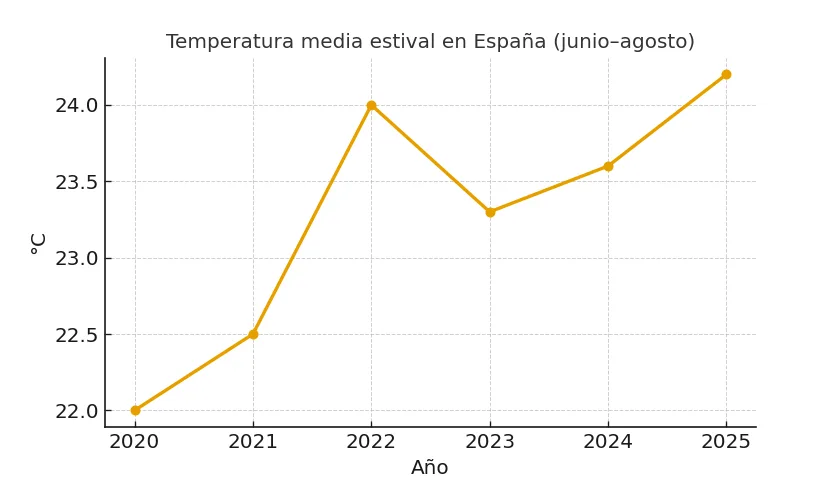
👉 The public now recognizes the heat as a structural problem. This opens a window to prioritize adaptation resources without fear of social backlash.
1. Figures that speak for themselves
That heat translates into hard numbers. The system MoMo of the Carlos III Health Institute attributes 3,644 deaths in Spain since June due to heat-related causes, a 84 % more than in the same period of 2024.
In Catalonia, the Public Health Agency confirmed that June registered 43 deaths attributable to the heat, the highest figure of the last decade.
This is not an isolated phenomenon. In 2022, also a record year, more than [number missing] were estimated. 4,700 deaths because of the heat. And if we go back to 2003, the great European heatwave left 70,000 victims across the continent. The trend is clear: each wave arrives earlier, lasts longer, and has a greater impact on health.
The tropical nights (minimums ≥20 ºC) and equatorial Temperatures above 25°C are increasing in large and medium-sized cities, preventing homes from cooling down. This particularly affects the elderly and those with chronic illnesses, who are more susceptible to heatstroke and dehydration.
👉 Mortality figures are the strongest argument for prioritizing investment in adaptation.
2. When the heat is concentrated in neighborhoods and schools
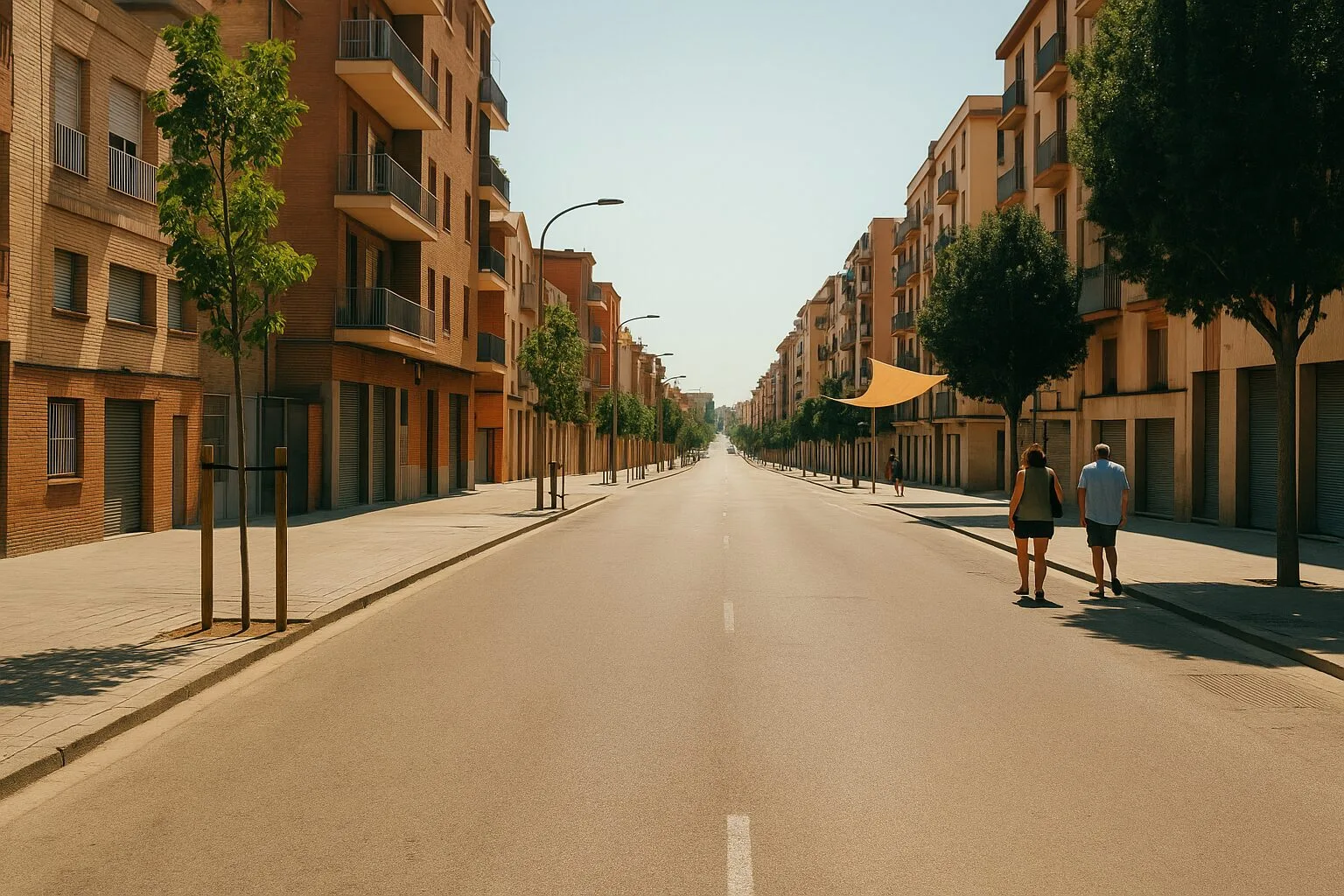
The heat doesn't affect everyone equally. urban heat island (UHI) It amplifies the exposure: neighborhoods with sparse vegetation or dark-colored materials retain more heat. The difference between a green neighborhood and an asphalt one can exceed 5–8 °C.
Recent studies in Madrid and Barcelona They show that areas with less vegetation cover coincide with lower-income, higher-density neighborhoods. This means that extreme heat is not only a climate problem, but also a problem of social and health equity.
The school environments are especially critical:
Patios without shade and with rubber or cement floors reach more than 60 ºC.
Classrooms without isolation turn the last months of the school year into a constant risk.
According to the Science Media Centre, Extreme heat affects learning, sleep, and children's mental health.
Barcelona has developed a climate shelter network in schools, libraries, and community centers. The goal is to ensure that everyone has access to a cool space in less than ten minutes walk. This criterion is beginning to consolidate itself as a new standard of urban equity.
👉 Prioritize school playgrounds and vulnerable neighborhoods. These are spaces where the heat has the greatest impact and where citizens most clearly perceive the improvements.

3. Europe demands it: climate adaptation and resilience
The European Union Adaptation Strategy It establishes three principles: adaptation faster, smarter, and more systemic.
The beginning DNSH (Do No Significant Harm) This sets a condition for all European public funding: no investment can harm the climate, water, biodiversity, or the circular economy. This criterion is mandatory for programs such as the PRTR, the funds FEDER or the Recovery and Resilience Mechanism.
The Horizon Europe Adaptation Mission It supports regions and municipalities in defining climate resilience plans. Examples already exist in France, Germany, and Italy that demonstrate how access to funding depends on proposals including verifiable adaptation indicators.
Within this framework, the projects that comprise green and blue infrastructure (trees, water, urban biodiversity) have more funding options.
A close example is Sant Boi Breathes + Green, awarded in 2025 by the Ministry for Ecological Transition and the Demographic Challenge This plan, recognized as an exemplary adaptation project, combines technical assessment, citizen participation, and the operational deployment of trees, shade structures, and climate shelters in neighborhoods and schools. Its recognition demonstrates how European strategy can be connected to local action.
👉 Ensure that every municipal measure is aligned with DNSH and European frameworks. This will be key to accessing funding.
4. Urgent and realistic measures
Below is a catalog of actions with evidence of impact and sufficient maturity for immediate implementation. We recommend addressing them in three phases. horizons: (1) fast and low cost; (2) structural; (3) systemic (regulations and governance).
Climate shelters in libraries, community centers, and sports centers, with extended hours and clear signage. Recommended accessibility criteria: <10 minutes walk.
Shade in school playgrounds: combinations of awnings, pergolas and trees. Typical reductions of 3–4 °C in the environment and >15 °C on surfaces exposed during school hours.
Shaded corridors in neighborhoods: drought-adapted trees and microforests on vacant lots, connecting schools, squares and transport stops.
Green roofs and facades: passive cooling and improved insulation in public facilities and social housing; compatible with energy retrofit.
Water in public spaces: drinking water sources, nebulization in squares and sheets of water where feasible, with efficient management and minimal loss.
Quick wins: cold paints on roofs and pavements, Replacement of dark plastic flooring in patios and improvement of reflective materials.
| Extent | Impact | Cost | Term | EU / DNSH | Use |
|---|---|---|---|---|---|
| Climate shelters | High | Low-Medium | Fast | Local/EU programs; DNSH | Libraries, community centers |
| Shade in patios | High | Half | Fast–Medium | Nature/efficiency; DNSH | Schools and nurseries |
| Shadow corridors | High | Half | Half | Urban green (LIFE) | School streets, pedestrian axes |
| Green roofs/facades | Medium-High | High | Long | EU taxonomy + rehab. | Facilities, social housing |
| Water in public spaces | Half | Half | Fast | Efficient management; DNSH | Squares with high foot traffic |
| Quick wins | Half | Low | Fast | Compatible with rehabilitation. | Existing patios and roofs |
👉 Combine quick wins visible through structural measures. Showing quick results facilitates public and political acceptance.
5. From diagnoses to actionable plans
A common problem: the municipal climate diagnoses They end up as lengthy reports with no practical translation.
The key is in developing executable plans that:
They prioritize measures based on impact and cost.
They define clear timelines.
Political and technical responsibilities are assigned.
They establish verifiable indicators (useful shade, hours of comfort, reduction of health emergencies).
Interdepartmental coordination is critical: urban planning, environment, education and social services They must work together.
Again, the example of Sant Boi Breathes + Green It is illustrative: it started with a diagnosis, turned it into an action plan with indicators, and ensured continuity through grant management and community participation.
5.1 How to finance these solutions
To speed up execution, prepare project sheets that translate each measure into goals, costs, schedule, responsible e verifiable indicators. Align from the beginning with:
Biodiversity Foundation – Renaturalization of Cities (FEDER/PRTR): renaturalization and nature-based solutions.
LIFE Programme (urban adaptation): projects of green infrastructure and thermal comfort.
Adaptation Mission (Horizon Europe): Support for regions and municipalities towards resilience 2030.
DNSH Criteria: integrates biodiversity, water and circularity in design, materials and maintenance.
Document results: ambient and surface °C, % of useful shade, accessibility to shelters (<10 min), hours of comfort during heat waves, reduction in healthcare services and co-benefits (biodiversity, social, water).
👉 The value lies not in the diagnosis, but in the operational plan. Think of each measure as a project with costs, responsible parties, and indicators.
6. Operational checklist for municipalities
FocusIt starts in schools, residences, and vulnerable neighborhoods.
DiagnosisIt cross-references temperature, income, and age. It identifies critical corridors.
Horizons: immediate (shelters, awnings), structural (trees, roofs), systemic (regulations, networks).
Indicators: % of useful shade, accessibility <10 min to shelters, reduction of health care, % vegetation cover.
Financing: prepare fact sheets with DNSH criteria and co-benefits (health, biodiversity, social).
Governance: creates an interdepartmental cell to coordinate actions.
Stake: co-design with schools and neighbors.
Transparency: publishes a dashboard of indicators and action schedule.
👉 This checklist can be used as a basic script for any municipal adaptation plan.
Our final message
The summer of 2025 marks a turning point. People are no longer talking about forecasts: they're talking about sleepless nights, of scorching school playgrounds and of neighbors who couldn't withstand the heat wave.
Official data confirms what we feel: heat kills, and it does so more each year. Europe demands climate adaptation and funds those who dare to implement it.
Municipalities that act today will be better prepared, not only to raise funds, but to protect their neighbors. The priority is clear: start with the most vulnerable environments, such as schools and densely populated neighborhoods.
👉 I want to take the first step
Get in touch with us without obligation.
Would you like us to notify you when we publish new content?
We value your time. We'll only send you articles, guides, or tools that help you improve, make better decisions, or take better action.
Our latest publications

From the institutional website to the intelligent service
Municipal websites were created to publish information. Citizens, however, need guidance and results.

Three common mistakes in institutional communication
The most common mistakes aren't strategic; they're in daily execution. Here are three errors that

Three mistakes that hinder a strategy of
In recent years, green infrastructure has gone from being an environmental concept to becoming

Clear institutional communication: keys to effective communication
In a saturated environment, medium and small cities can gain ground if they adapt their messaging

How to approach a green infrastructure strategy
In many municipalities, the green infrastructure strategy starts with momentum but then cools down amidst paperwork.

R&R Route for institutions, tailor-made solutions for
The Institutional R&R Route. It's not just another technical report or a generic recipe. It's the

How to apply AI in municipal management
The municipal teams are exhausted. Every day they draft minutes, reports, specifications, certifications and memoranda; they correct versions,

Three mistakes when implementing AI in the
Each year, more city councils announce their move to artificial intelligence. The headlines sound promising: automation

When institutional communication does not adapt
Digitization is already present in city councils and companies, but it often remains just "publishing on

AI in local councils: from resistance
What is hindering the adoption of AI in local governments, what changes with the AI Act, and