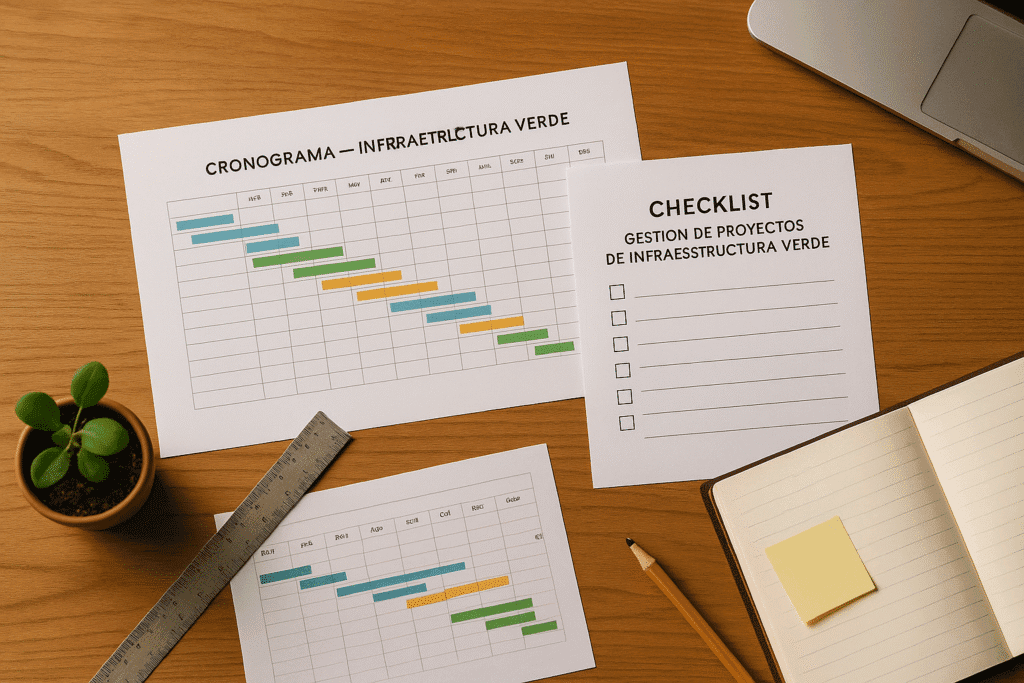
Initial checklist – Green infrastructure project management.
Evaluate whether your municipality has the necessary capacity to manage and coordinate green infrastructure projects from start to finish.
How to read it: Mark ✔ only if you have it implemented regularly, with verifiable results, not just as a good intention.
How to interpret the results?
Warning sign: If 5 or more boxes remain unchecked, your municipality is managing green infrastructure projects with a fragile model that generates delays, cost overruns, and last-minute justifications.
What usually happens: Projects take longer than planned, only a portion of what was approved is executed, and teams end up overwhelmed, with incomplete reports and the risk of returning European funds.
The reality: Even small municipalities can successfully manage complex projects if they organize clear committees, realistic timelines, and orderly tracking of tasks and documentation using standard tools.
Do you want to know all the details of our services?
👉 If you want to ensure that upcoming projects are completed on time and under control, schedule a no-obligation exploratory meeting.
Would you like us to notify you when we publish new content?
We value your time. We'll only send you articles, guides, or tools that help you improve, make better decisions, or take better action.
Green infrastructure project management checklist
The urban green infrastructure requires a project management structured, from planning to execution and maintenance. This initial checklist allows any municipality to quickly assess whether it has the necessary processes and resources to effectively manage green projects, aligning with recognized methodologies such as those of Project Management Institute (PMI) for the management of complex initiatives.
Through simple questions, aspects such as the existence of prior planning, coordination between municipal departments, and the capacity to monitor works and actions are assessed. The result provides a clear snapshot of the starting point and helps identify gaps that may delay the implementation of strategic projects, while also incorporating best practices in project management endorsed by the Spanish Association of Integrated Project Management (AEDIP).
Furthermore, this tool serves as a practical guide for municipal technicians and managers who need to assess their preparedness without spending weeks on complex audits. It allows them to compare their current situation with basic management standards, identify bottlenecks in implementation, and focus their efforts on priority actions. In this way, not only is internal efficiency strengthened, but the capacity to secure funding and justify projects to other government bodies is also enhanced.
Having a self-assessment system like this is key to moving from idea to action. It facilitates prioritizing interventions, strengthens coordination, and ensures that each project has clearly defined responsibilities, realistic timelines, and monitoring mechanisms. This is an essential step for green infrastructure to deliver tangible benefits in sustainability, urban resilience, and quality of life.
Our latest publications

Three mistakes that hinder a strategy of
In recent years, green infrastructure has gone from being an environmental concept to becoming

Clear institutional communication: keys to effective communication
In a saturated environment, medium and small cities can gain ground if they adapt their messaging

R&R Route for institutions, tailor-made solutions for
The Institutional R&R Route. It's not just another technical report or a generic recipe. It's the

Three mistakes when implementing AI in the
Each year, more city councils announce their move to artificial intelligence. The headlines sound promising: automation

How to apply AI in municipal management
The municipal teams are exhausted. Every day they draft minutes, reports, specifications, certifications and memoranda; they correct versions,

AI in local councils: from resistance
What is hindering the adoption of AI in local governments, what changes with the AI Act, and

When institutional communication does not adapt
Digitization is already present in city councils and companies, but it often remains just "publishing on

From the institutional website to the intelligent service
Municipal websites were created to publish information. Citizens, however, need guidance and results.

Adaptation to extreme heat: urgent measures and
Spain's hottest summer on record confirms that extreme heat is already a reality.

Three common mistakes in institutional communication
The most common mistakes aren't strategic; they're in daily execution. Here are three errors that

How to approach a green infrastructure strategy
In many municipalities, the green infrastructure strategy starts with momentum but then cools down amidst paperwork.