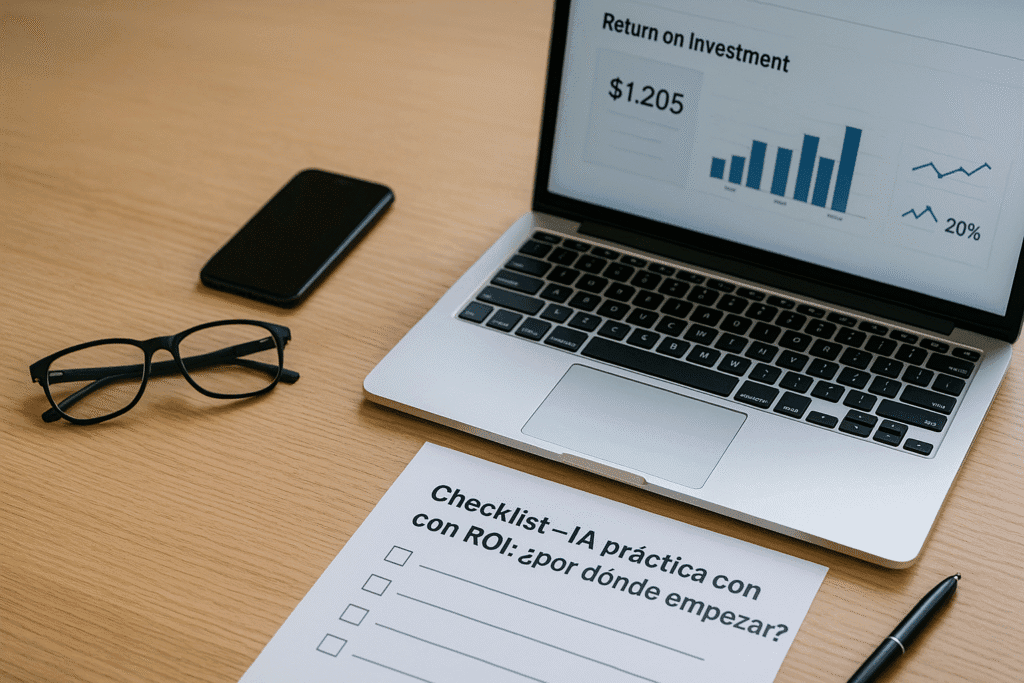
Practical AI Checklist with ROI: Where to Start?
A professional starting point to understand how to apply artificial intelligence practically and profitably in your business.
In 14 questions, you can determine if your company is ready to implement artificial intelligence in a practical and profitable way. At the end, you'll receive a visual result with the most suitable recommendation for your business, which you'll also receive by email.
Do you want to review the results of your checklist in detail?
👉Schedule a no-obligation exploratory meeting and let's review together how to take the next step.
Would you like us to notify you when we publish new content?
We value your time. We'll only send you articles, guides, or tools that help you improve, make better decisions, or take better action.
Practical AI Checklist with ROI: First Step to Profitable Adoption
He Practical AI checklist with ROI It is designed to help SMEs and larger companies easily assess whether they have the necessary foundation to realistically and profitably implement artificial intelligence. In many cases, managers already suspect that AI could bring efficiency or new opportunities, but they don't know where to begin or what internal barriers are hindering its adoption. This self-assessment provides a clear framework to validate these intuitions and prioritize the areas where action is needed.
One of the main mistakes in the business use of artificial intelligence is thinking that simply incorporating isolated tools is enough. The reality is that, without a clear strategy, well-structured data, and adapted processes, AI does not generate a return on investment. As explained HubSpot in its guide to artificial intelligence for businesses, The key is to align technology with business and marketing objectives, rather than adopting solutions disconnected from day-to-day operations. This checklist helps determine if your organization is at that point or if it needs to strengthen its foundation first.
Furthermore, the adoption of AI with a return on investment requires a practical approach. It's not about following trends or undertaking large, unattainable projects for an SME, but about identifying concrete uses with a real impact on productivity, sales, or customer service. According to Think With Google, Companies that approach artificial intelligence gradually, measuring results at each stage, are the ones that manage to consolidate a positive and sustainable ROI.
This Practical AI checklist with ROI This comprehensive review assesses your company's readiness: from data management and your team's digital culture to strategic clarity and the ability to measure results. By the end, you'll have a clear picture of your starting point and concrete recommendations for the next steps. This information isn't an end in itself, but rather the beginning of a structured and focused transformation process to unlock your business's full potential.
Ultimately, this resource will allow you to move from doubt to action with greater confidence and sound judgment. Knowing if your company is truly ready for artificial intelligence is the first step to leveraging its potential practically, with a measurable return applicable to your future growth strategy.
Beyond the initial self-assessment, this checklist also serves another key function: raising awareness within the organization. Often, teams hear about artificial intelligence as an abstract, distant concept, or one exclusive to large corporations. By answering these questions, it becomes clear that AI can be applied to everyday aspects of any SME: from automating repetitive tasks to improving customer service or strengthening decision-making with reliable data. Understanding where you are and what still needs to be done is the essential step to transforming curiosity into tangible results.
Our latest publications

Three mistakes that hinder digitization (although
In recent years, thousands of SMEs have invested in digital tools, training and subsidized services

Three mistakes that slow down ROI in
AI doesn't fail because of technology, it fails because of management. If you run an SME and want to convert

How to create a website that is understandable by the
OpenAI has integrated its assistant directly into a browser: actionable summaries, comparisons, and semi-automatic tasks

Where AI does save time (and
In SMEs, AI isn't a universal shortcut. It doesn't save you from thinking: it saves you from repeating.

Three blocks that slow down the alignment of
When marketing, sales, and operations aren't rowing in the same direction, the problem is rarely

Three mistakes that hinder growth
Many small and medium-sized enterprises (SMEs) have energy, effort, and goodwill. What's lacking is clarity on how to connect that effort.

AIO Analytics: How to measure combined visibility
Traditional SEO measured positions, impressions, and clicks. Today, some visibility happens outside of those areas.

The OpenAI browser for SMEs and startups:
OpenAI has integrated its assistant directly into a browser: actionable summaries, comparisons, and semi-automatic tasks
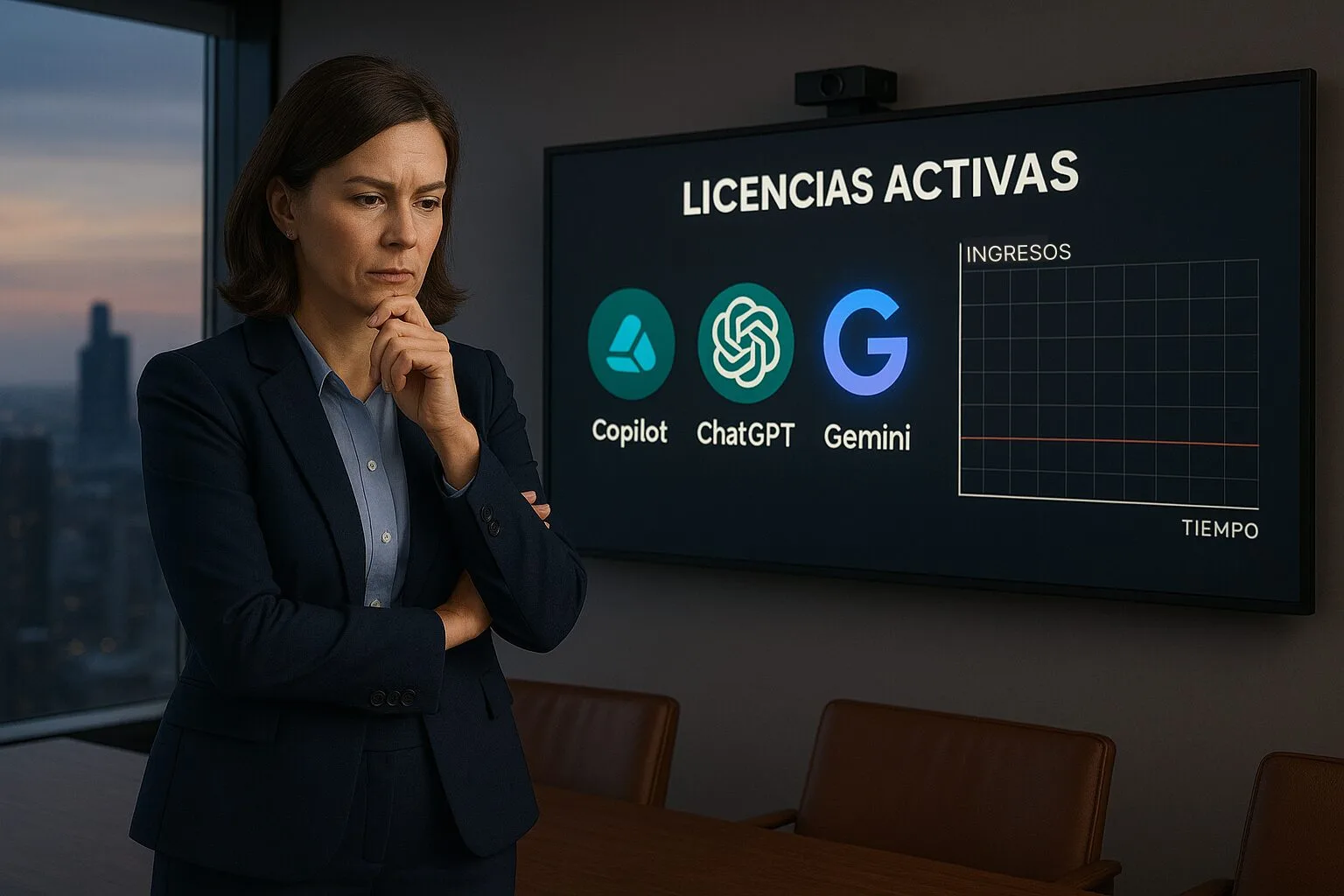
Copilot or ChatGPT does not mean having intelligence
The 80% for SMEs uses AI only because it's included in their suite. This analysis explains.

How to grow without drowning in digital tools
Many SMEs have accumulated a stack of CRM, email, networks, automation, analytics and AI out of fashion or fear of "being left behind".

External consultant vs star signing
Choosing between an external consultant and a star internal recruit is a key strategic decision.

Funnel case study: how an SME
A lead generation and conversion funnel isn't just a pretty graphic: it's a living system that

AI with ROI for small and
Artificial intelligence is no longer a luxury for large companies or startups: it's also available to everyone.

5 signs you need to redefine your
Are your sales not growing, are customers comparing you based on price, or is your team performing poorly?

From SEO to AIO: how to be relevant
Many SMEs still measure their "digitalization" by having a website and social media presence. The market is moving two steps further.

Where is your growth leaking from? (diagnosis)
Many small and medium-sized enterprises (SMEs) have energy, effort, and goodwill. What's lacking is clarity on how to connect that effort.

How to align marketing, sales, and operations: what
In SMEs, AI isn't a universal shortcut. It doesn't save you from thinking: it saves you from repeating.

Three mistakes that dilute a plan
Having a plan isn't enough: if it gets diluted in practice, it won't move the needle. Identify

Avoid paralysis by tools and automation
Many SMEs fall behind not due to a "lack of digitization", but due to excessive complexity: