
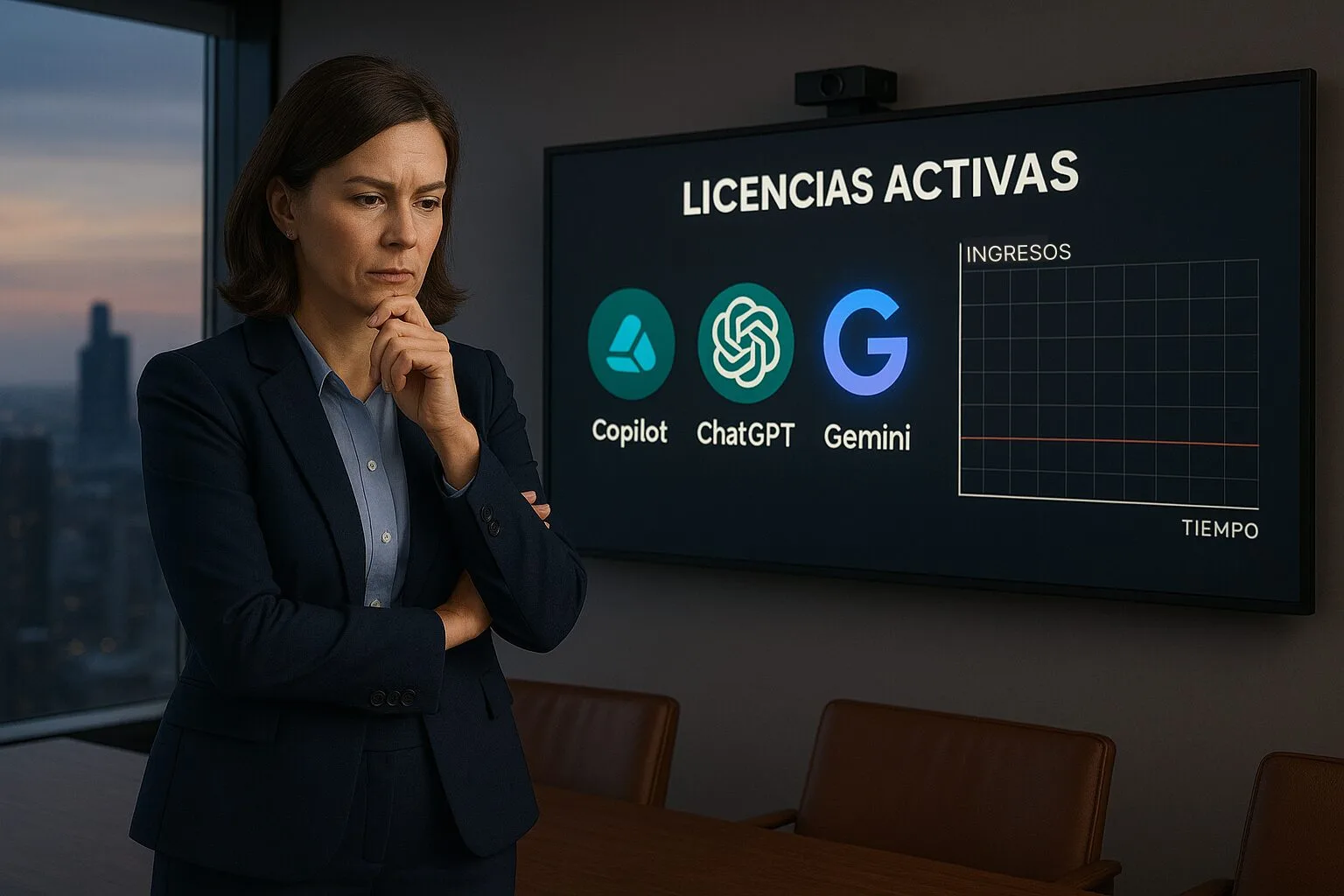
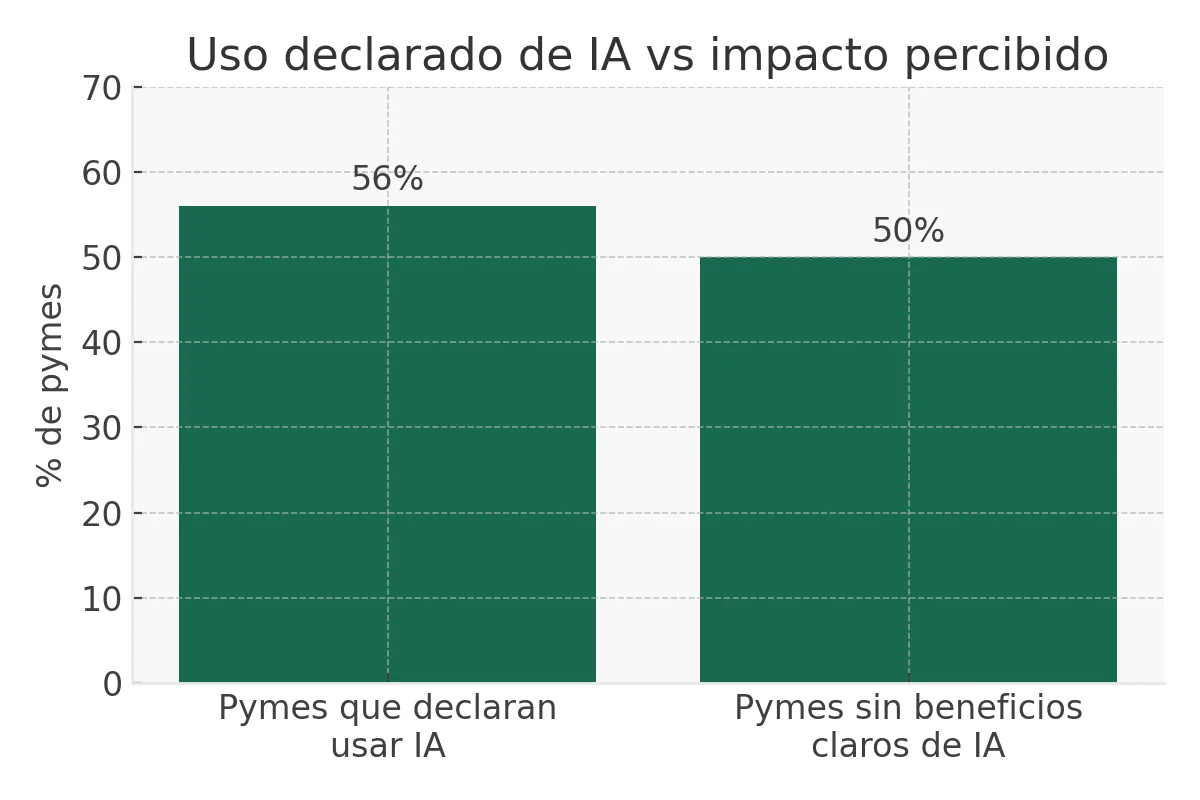
More and more SMEs claim that they already use artificial intelligence because they pay for it. Copilot within the Microsfoft pack,They have licenses for ChatGPT or they have activated Gemini in Google Workspace. But when you get down to the nitty-gritty, the numbers tell a different story: around 56% of Spanish SMEs report using AI,and yet Between 40% and 60% of the % figures, there are no clear benefits to the business..
This article explains, without fluff, why paying for Copilot or ChatGPT doesn't mean your company "has AI," what's really happening with AI adoption in SMEs, and what concrete decisions a CEO needs to make if they want real results by 2026.
Various barometers place the declared use of AI in Spanish SMEs at around half of the fabric, with adoption that has grown rapidly since 2022.
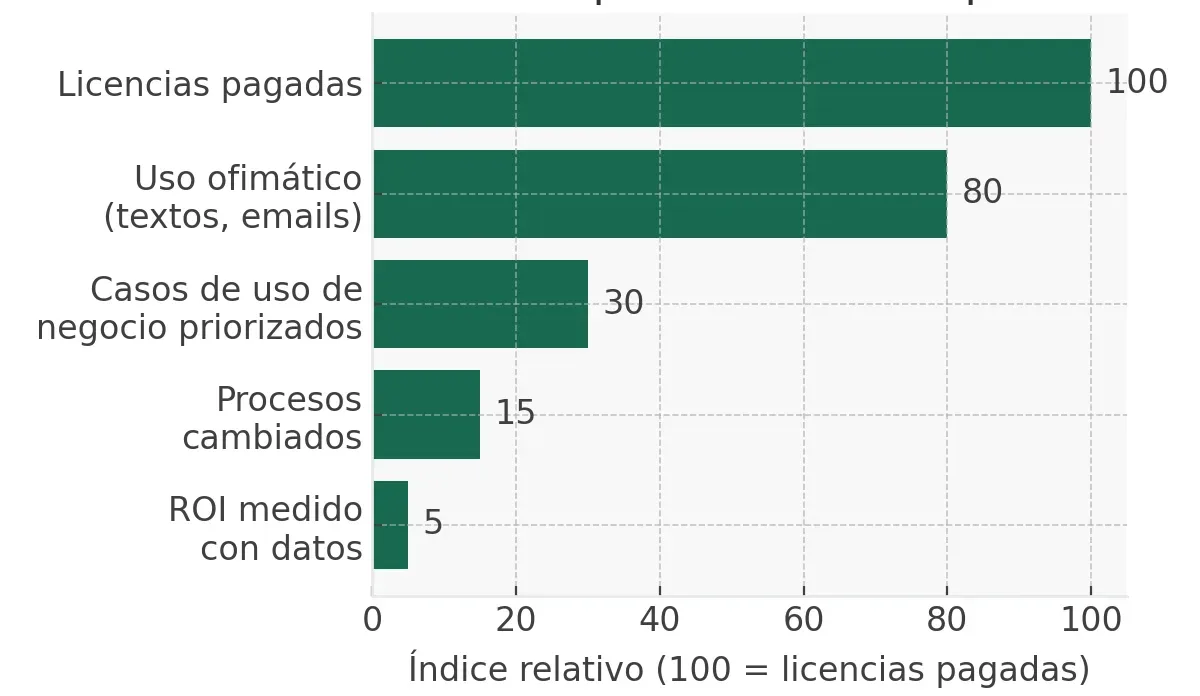
More than 80% of AI use in SMEs is concentrated in tools integrated into suites that were already paid for: Microsoft 365, Google Workspace or ChatGPT plans.
Nine out of ten users say they draft, summarize, and prepare documents faster when using generative AI on their desktop.
Depending on the study, between 40% and 60% of companies acknowledge that they still do not see a tangible impact of AI on sales, margin, or costs.
- What's really happening with Copilot, ChatGPT, and Gemini in SMEs
- The false sense of adoption: “we already use AI in the company”
- Why are you still not seeing ROI even though you pay for Copilot or ChatGPT?
- Smoke-free AI for SMEs: what it really means
- Four areas where AI does generate money for an SME
- Specific decisions a CEO must make if they want results by 2026
- How to move forward without burning through budget (and what the next step should be)
- Quick FAQs about Copilot, ChatGPT and AI in SMEs
1. What's really happening: Copilot or ChatGPT doesn't mean having artificial intelligence in your company
Looking at recent reports, the overall picture seems positive: close to 56% of Spanish SMEs report using AI to some degree, and interest in technology has clearly grown since 2022.
But when you get into the details, the key nuance emerges: around a 80% of that usage is concentrated on tools linked to suites you already paid for. (ChatGPT, Copilot, Gemini), not in projects designed from a business perspective. AI comes "packaged" in the Microsoft 365 or Google Workspace refresh, not as the result of a strategic management decision.
The typical cycle in many SMEs is this:
-
AI enters through the licensing door.
Microsoft adds Copilot to the package, Google incorporates Gemini, someone suggests hiring ChatGPT Teams "to try it out". -
The decision comes from the supplier, not the business.
The question is not "what process do we want to improve," but "how do we take advantage of what we already pay for.". -
Exploration is delegated downwards.
Around half of CEOs admit to delegating AI exploration to middle managers or technical teams, without setting clear use cases or KPIs. -
AI remains trapped at the desk.
Actual usage is concentrated in Word, Excel, email and presentations; it barely touches sales processes, operations or customer service.
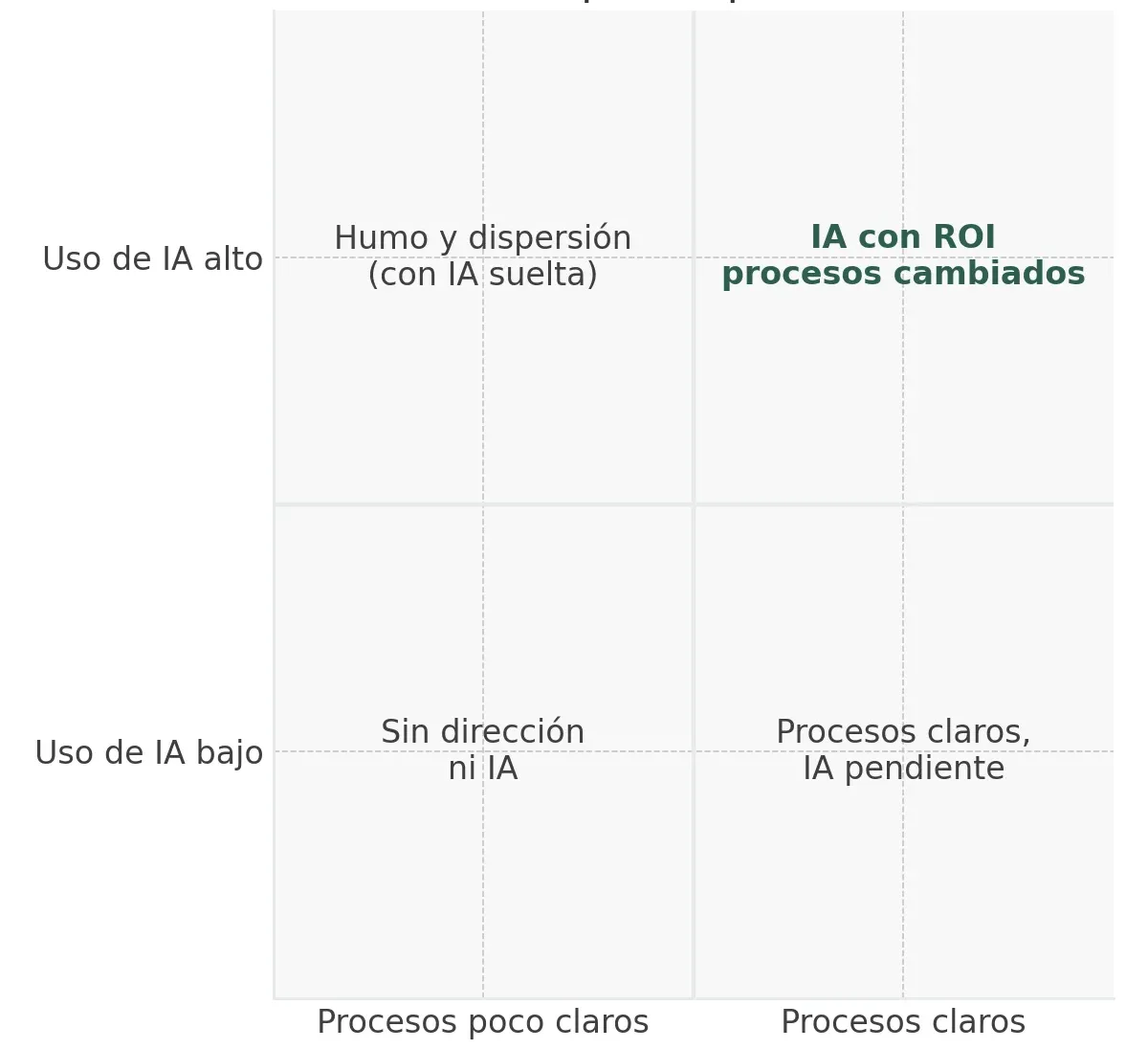
Most SMEs haven't yet designed "their AI project." What they have is AI of drag: it enters pushed by the suites it already paid for, it is tested in a scattered way and ends up concentrated on desktop tasks, far from the processes that generate margin.
2. The false sense of adoption: “we already use AI in the company”
When you ask those who already use AI in their daily lives, the data is clear: Over 90% of % reports having gained individual productivity Writing, summarizing, or preparing documents. In other words, people feel they work faster with Word, Excel, email, and presentations.
However, when the question changes to “"Has anything changed in your sales, margins, or costs?"”,between a 40% of companies acknowledge that they do not see clear benefits..
The reason is simple: in many organizations, “using AI” means only this:
- write emails faster,
- summarize meetings or long documents,
- draft reports,
- create presentations with less effort.
Higher individual productivity, less time spent glued to the screen, and the feeling that "we're getting more done." This is the most widespread use of Copilot, ChatGPT, or Gemini in Spanish SMEs today.
Measurable changes in how you attract, serve, and retain customers, how you plan, purchase, produce, or deliver, and how you make decisions. Fewer errors, lower costs, and faster response times.
3. Why are you still not seeing ROI even though you pay for Copilot or ChatGPT?
Many CEOs express the same feeling: we've tested it, the team uses it, but We don't know how much it really contributes..It's not by chance. There are five recurring reasons why ROI doesn't appear.
3.1. Start with the tool, not the problem
The usual order is: hire Copilot or ChatGPT, tell the team to use it, and "see what happens." The correct order would be:
- Choose a specific business problem (slow proposals, billing errors, overloaded support),
- define a measurable objective (times, errors, costs),
- and only then look at how AI can help there.
As long as the starting point is the tool, dispersion is guaranteed.
3.2. Data that is too disorganized
In industrial and B2B service SMEs, the pattern is well known: incomplete CRMs (In many studies, over 60% of % companies acknowledge having fragmented customer data), ERPs with duplicate references and parallel spreadsheets in each department. Adding AI to this context doesn't improve processes; it amplifies the chaos.
3.3. Nobody owns the business of AI projects
In a significant portion of companies, IT tests things, marketing tests things, and operations reviews some pilot programs. But There is no business person who owns a specific use case with KPIs and a timeframe.Various reports indicate that more than half of companies are "testing AI" without assigning a clear business owner. The result: endless pilot programs with no decisions being made.
3.4. Fear of regulation and loss of control
The combo GDPR + AI Act This raises reasonable questions: what data can be used, what can be uploaded to Copilot, where is the limit of automation? Without a clear policy, the knee-jerk reaction is usually: Use AI only for low-risk tasks (writing, summaries) and not touching critical processes, right where the ROI is.
3.5. Pilot fatigue: 9 out of 10 end up with nothing
Different analyses agree on one uncomfortable fact: Most AI projects fail to generate ROI because they remain poorly defined pilot projects or disconnected tests. Some studies even mention up to 9 out of 10 initiatives that do not make it past the pilot phase due to vague objectives, poor data, and a lack of collaboration between areas.
In addition, around 25-30% of companies have halted AI projects in recent months, and more than half see risks of a "bubble" or over-expectation, comparing it to what happened with blockchain.
| Reason for non-ROI | Approximately % of affected SMEs | Brief comment |
|---|---|---|
| Tool before problem | ≈ 60 % | It starts with "let's try Copilot/GPT" and not with a specific business objective. |
| Disordered data | ≈ 65 % industrial | Incomplete CRM/ERP systems, parallel spreadsheets, and low confidence in the underlying data. |
| No business owner | ≈ 50 % | Pilots scattered without a clear leader or assigned KPIs. |
| Fear of regulation and security | ≈ 30 % managers | Doubts about GDPR and the AI Act lead to limiting AI to harmless tasks. |
| Pilot fatigue | 9 out of 10 projects | Tests that are neither scaled nor closed with a clear decision. |
4. Smoke-free AI for SMEs: what it really means
Before discussing tools, it's important to clarify the framework. For an SME, Smokeless AI means:
- talk about specific use cases, not of “total transformation”;
- measure impact on hours, euros, errors and times;
- prioritize what you can accomplish in months, not years;
- Don't give up on grandiose projects that your team can't handle.
1. AI is not an image campaign, it's part of your company's operating system.
2. The question is not “which model do we use”, but “which process do we want to improve first”.
3. Without defined KPIs, any AI project is expensive noise.
4. Better three impactful use cases than twenty experiments that nobody looks at.
5. If you can't explain the return in one slide, you haven't got it right yet.
You don't need an 80-page "AI strategy." You need to be able to answer this clearly:
- In what specific processes do we want to see changes in the next 12 months?
- What numbers do we want to move and by how much?
- Who will be held responsible if that happens?
5. Four areas where AI does generate money in an SME
Beyond writing emails faster, there are at least four areas where AI is already generating tangible ROI in SMEs when applied judiciously.
Assistants that suggest responses, categorize tickets, and summarize interactions allow you to see increases of up to a 15–20 % in tickets resolved per agent in many real-world projects. That means more capacity with the same team and better response times for the client.
Generating proposal drafts with AI from CRM templates and data is reducing preparation time by a 25–50 % (For example, going from five days to two). Arriving before the competition and with better proposals translates into more closed deals.
Automating the extraction of data from invoices, orders, or delivery notes and generating recurring reports can save hundreds of hours per year, even for small businesses. ROI is easy to measure: hours saved × cost per hour more mistakes you stop making.
Detecting demand patterns and prioritizing incidents with AI, even with relatively simple models, helps reduce stockouts, overstocking, and emergencies. In industrial and retail sectors, small improvements in forecasting directly impact profit margins.
6. Specific decisions a CEO must make if they want results by 2026
If you run an SME, the key question isn't "Copilot, Gemini, or ChatGPT?". The question is: “"In what three critical processes do I want to see real change in the next 12 months?"”.
6.1 · Choose three use cases, not twenty
One person in customer service/sales, one in operations/service, and one in back office. More than three at the beginning usually leads to dispersion and frustration.
6.2 · Appoint a business manager per case
Someone who understands the process, experiences the problem firsthand, and has the real power to change how things are done. IT and technology providers are support staff, not project owners.
6.3 · Put numbers before talking about tools
How much time is invested today, how much does it cost, what mistakes are generated, what timeframe are you working with? Without a baseline, talking about ROI is just talking about feelings.
6.4 · Put a watch on each pilot
Define the duration (8–12 weeks), metrics to monitor, and criteria for scaling, adjusting, or stopping. A pilot program without an end date is an expensive hobby.
6.5 · Take advantage of your suite without limiting yourself to it
Get the most out of Copilot or Gemini if they fit your goals, but don't force a use case just to "take advantage of the license." The criterion is always the same: which best solves the problem at the lowest reasonable cost.
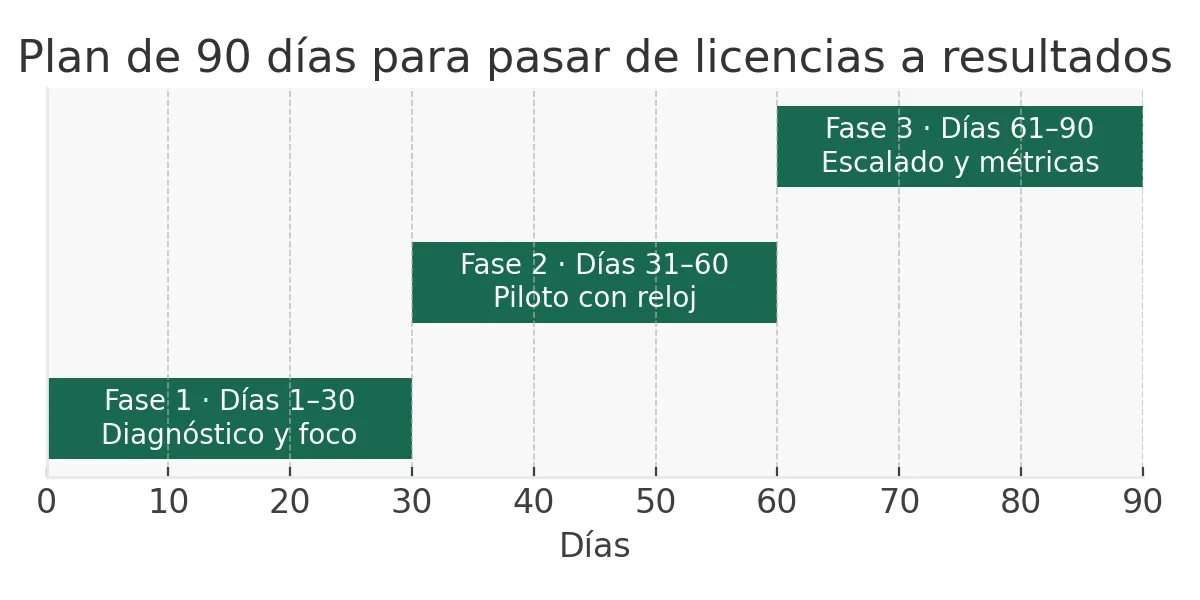
7. How to move forward without burning through the budget (and what the next step should be)
Applying AI meaningfully doesn't require rebuilding your entire company, but it does require clarity on three fronts:
- minimally sorted data in the processes you want to touch.
- Processes that are stable enough so that we can measure before and after.
- Explicit decisions about where you want to win first and what you're going to leave out.
As a reasonable next step, you can:
- Identify Three use cases with potential ROI in 90 days (one in sales, one in operations, one in back office).
- To easily estimate the current time and cost of each process.
- Prioritize the one where the combination impact × ease be more favorable.
- Define a mini-pilot with a clear timeline and KPIs for the first quarter.
To avoid getting lost, you can rely on a specific checklist of "3 AI use cases with ROI in 90 days" and review in a short session whether you are choosing the right place to start.
At Rumbo & Resultados we work precisely on that step: going from “we have Copilot/ChatGPT” to “We have three use cases with measurable ROI”.
- Express diagnosis of AI adoption and processes with the most potential.
- Selection and design of 3 use cases with ROI in 90 days.
- Practical guide for (smoke-free) equipment and tracking board.
The goal is not to fill your company with tools, but to help AI start appearing in your numbers: margin, times, errors, and sales.
If you'd like, you can start by downloading a checklist of "3 AI use cases with ROI" and scheduling a 15-minute exploratory session to review together what best fits your company.
8. Quick FAQs about Copilot, ChatGPT and AI in SMEs
Clear answers to the most common questions when an SME already pays for Copilot or ChatGPT, but is not sure if it is really taking advantage of artificial intelligence.
Why doesn't paying for Copilot or ChatGPT mean having AI in my company?
Because having active licenses only indicates that you have the tools. Having artificial intelligence in your company means that those tools are changing key processes and metrics: times, costs, errors, sales, margin. If none of that is changing, no matter how much Copilot or GPT you pay for, AI hasn't truly entered your business.
How do I know if I'm only using AI "on the desktop"?
If most of your usage is concentrated on writing emails, summarizing minutes, preparing presentations, and drafting documents, and you can't point to any processes where times have changed or errors have occurred, you're in "desktop" mode.
Where should a small business that is in the testing phase begin?
Choose three key processes (customers, operations, back office), appoint a manager for each, and define baseline metrics. Then, explore the potential role of AI in each case and design a pilot program with clear timelines and KPIs for the first quarter.
What is the real risk that this is all a bubble?
The bubble is built on expectations and exaggerated promises, not on the technology's ability to save time and reduce errors when applied correctly. Companies that achieve measurable results will gain the advantage; those that only purchase licenses will reinforce the feeling of a bubble.
What should I ask myself as a CEO before investing more in AI?
Three simple questions:
1) What process do I want to be clearly better in 12 months thanks to AI?
2) Who will be responsible for that happening?
3) What am I measuring today to know if we are making progress?
If you can't answer them, you don't need more AI; you need more clarity.