
R&R Route: Clarity and real results to keep your company moving forward on a firm course.
How we work to help your company move from stagnation to orderly growth
Published on October 31, 2025 · Category: R&R Route
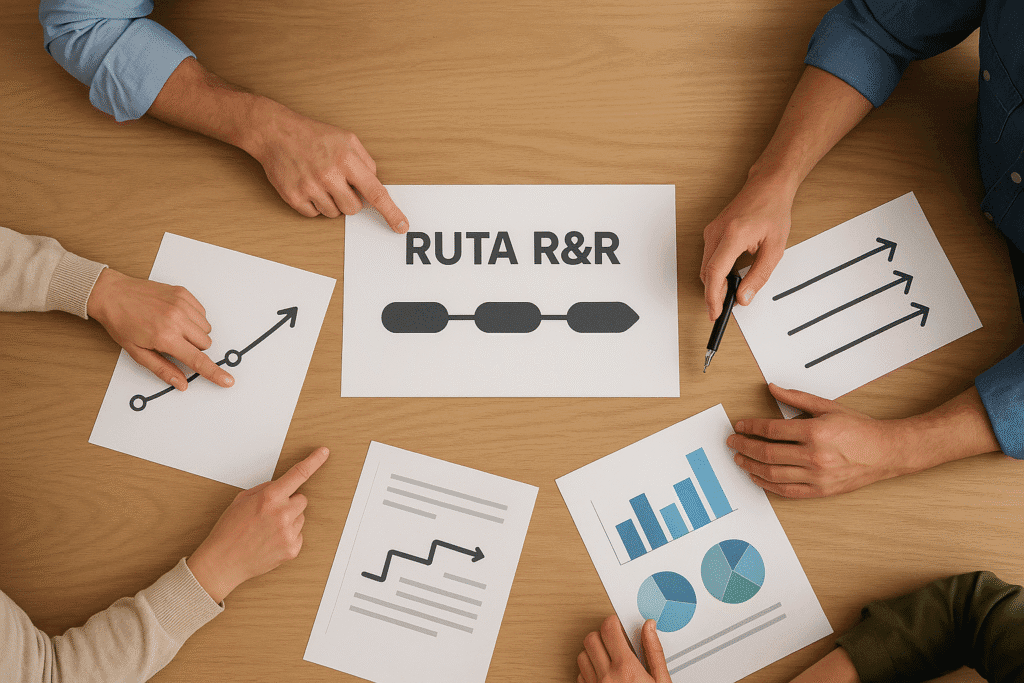
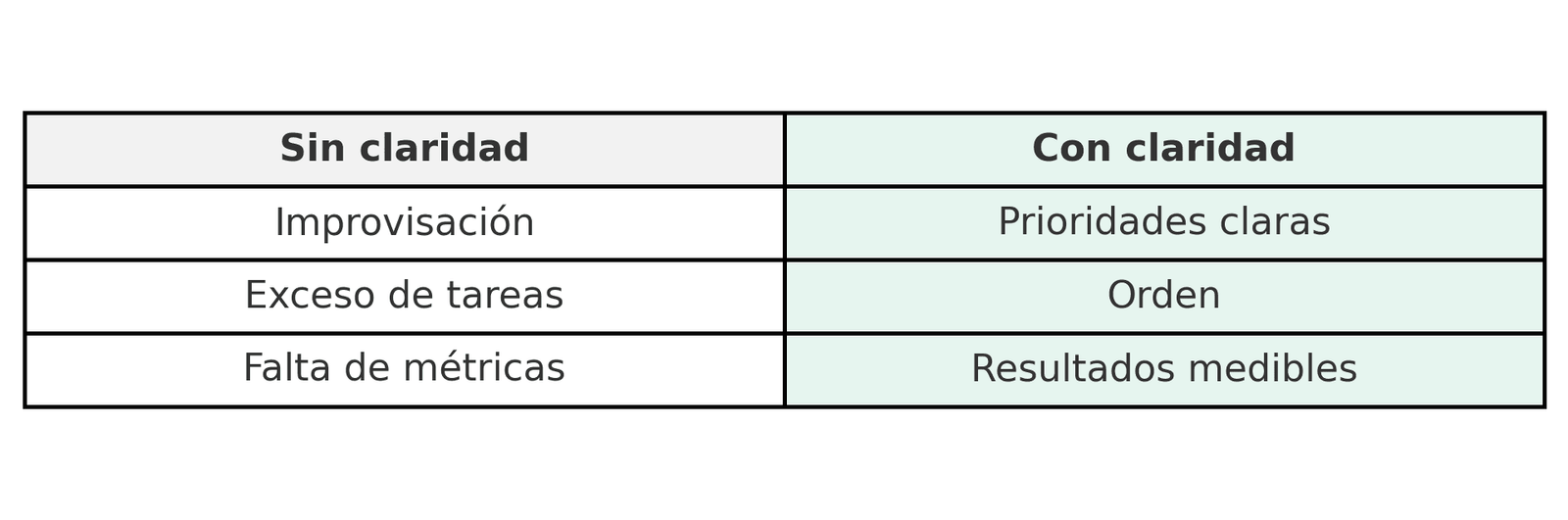
Many small and medium-sized enterprises (SMEs) and startups in their growth phase follow the same pattern: they work hard, but always with the feeling of improvising, constantly putting out fires, and without a clear direction. They invest in marketing, technology, or processes, but the results don't materialize as they should because they lack a methodology that provides order, priorities, and a realistic path for their size and resources.
That's where the R&R Route. This is not just another consulting report or a generic recipe. It's how we work at Rumbo & Resultados: our own methodology, developed from over two decades of experience in multinational corporations, startups, and public administrations, and perfected in real-world projects where the important thing wasn't having a pretty PowerPoint presentation, but making progress and achieving results.
The R&R Route is modular: you can start with the diagnosis, the strategy, the operational plan, or any phase you need. Each module provides value on its own, but together they form a system that helps companies move beyond improvisation and advance with focus, clarity, and tangible results.
Origin and philosophy of the R&R Route
The R&R Route stems from a simple observation: many companies know what they want to achieve, but they don't know—or can't—how to plan the path to get there. Large consulting firms offer rigid methodologies, full of bureaucracy and poorly adapted to the reality of an SME or startup. Independent consultants, on the other hand, often remain isolated advisors without the capacity for real-world implementation.
The three pillars of the R&R Route
- Hybrid experience: More than 20 years working in global multinationals, in partnership with SMEs, in growth-stage startups and public institutions.
- Innovation and technology at the service of the company: We use AI, digital tools and data alongside agile methodologies inspired by technology projects, only where they provide real value.
- Agility and modularity: Each phase of the R&R Route can be contracted independently, without endless processes or artificial dependencies.
The philosophy is clear: less bureaucracy, more action; less theory, more results.
The 5 phases of the R&R Route
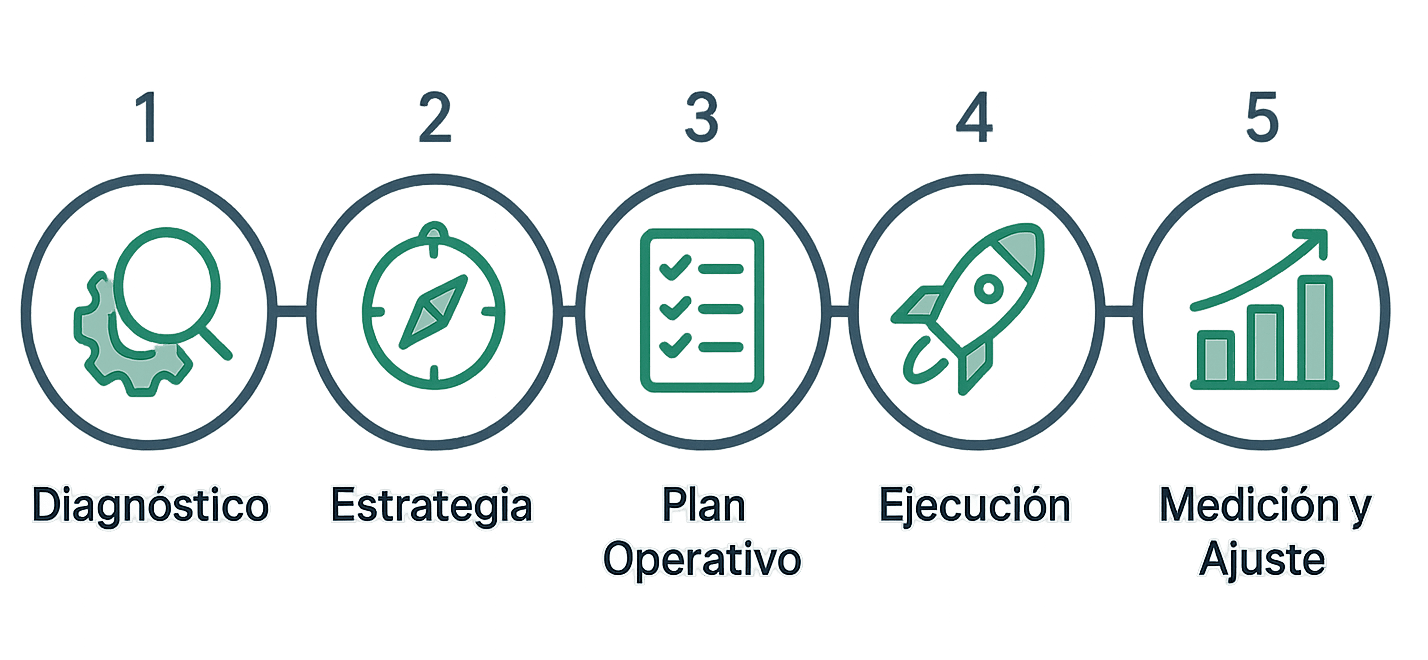
The R&R Route is structured in five phases. Each one can be contracted independently, but together they form a complete journey that transforms the way an SME or startup organizes its growth.
- Diagnosis – quick clarity on blocks and levers.
- Strategy – clear priorities and a realistic plan.
- Operational Plan – who does what, when and with what resources.
- Execution – moving from PowerPoint to action.
- Measurement and Adjustment – stay the course and anticipate.
Phase 1 – Diagnosis
At Rumbo & Resultados, we don't deliver endless or generic reports. Our diagnostics are fast, actionable, and designed to help SMEs and startups understand exactly what's blocking their growth and where to begin addressing it.
What do we do?
-
We reviewed key data: from Google Analytics and CRM to other ways of attracting and managing customers.
-
We analyze tickets and customer feedback, using AI to detect patterns invisible to the naked eye.
-
We spoke with the teams —sales, operations, marketing— in brief, focused interviews.
-
We reviewed prices and value proposition compared to the competition.
-
We observe critical processes: acquisition, attention, conversion, and support.
-
We measure customer and cohort retention to understand what hinders their loyalty.
-
We use our own diagnostic document, inspired by the RFP format, which organizes and streamlines the analysis much more clearly than a standard audit.
What does the company get?
-
An Excel spreadsheet with the key findings.
-
A document (PDF) with conclusions and action plan, executable by the company itself or by any supplier.
-
An initial dashboard in Excel with 6 KPIs ready to start measuring results.

What we avoid
-
Long reports with no actionable elements.
-
Generic comparisons that are not relevant to the company's context.
-
Diagnoses without speaking to sales, marketing, product, or actual customers.
-
Recommendations that ignore the actual capacity or costs of the SME/startup.
-
Models that create dependency: we always train teams so that they can continue on their own.
According to an analysis of McKinsey, more than 70% of business transformations fail not due to a lack of strategy, but due to the absence of a clear and actionable execution plan.
👉 Example: in a distribution SME, the bottleneck was not marketing, but the lack of sales follow-up.
Phase 2 – Strategy
Once the growth blocks and levers have been identified, the next step is to shape a clear and applicable strategy.
What do we do?
-
We prioritize critical problems and turn them into strategic priorities.
-
We translate those axes into an action plan with phases, priorities, and a logical order.
-
We apply a cost/benefit criterion that includes team effort and wear and tear, not just financial investment.
-
We compare each proposal with success stories adapted to the client's context.
Customer format
-
An Excel spreadsheet with strategic pillars, priorities, and phases.
-
A short PowerPoint presentation to align the management team.
What we avoid
-
Generic strategies of the "get more digitized" type.
-
Manual plans applied serially.
-
Extensive and disorganized documents that confuse more than they clarify.
As it points out Harvard Business Review, Companies that apply simple and adapted criteria—such as cost/benefit or impact/effort—are better at prioritizing than those that try to replicate complex frameworks typical of large corporations.
👉 Example: In a digital startup, three key functionalities were prioritized and eight that consumed resources without return were paused.
Phase 3 – Operational Plan
Defining the strategy is key, but without a detailed operational plan it remains just on paper.
What do we do?
-
We turned the strategy into a clear timeline with phases, times, and responsible parties.
-
We involve each department at the right time to avoid bottlenecks.
-
We apply agile methodologies: action backlog, scheduled meetings, decision committees, and checkpoints to resolve roadblocks.
-
We maintain control with useful mechanisms inspired by Scrum, adapted to the size of the company.
Customer format
-
Backlog of actions in Excel with visual timeline.
-
RACI matrix that clarifies responsibilities.
-
Definition of decision committees and frequency of meetings.
-
Checklists by action block to validate progress.

What we avoid
-
General plans that lack detail.
-
Canned proposals that are repeated client after client.
-
Unequal services (dedication to large corporations and canned solutions for SMEs).
👉 Example: In an industrial SME, reorganizing the budgeting process reduced closing time by 30%.
Phase 4 – Execution
This is where strategy becomes real action.
What do we do?
-
We offer different levels of involvement: from external consultant to temporary interim management.
-
We coordinate committee meetings: management (bi-weekly), block managers (weekly) and operational teams (brief daily meetings to resolve blockages).
-
We lead or assist in the coordination of suppliers and agencies.
-
We go into detail wherever the client requests it: campaigns, operations, or negotiations with suppliers.
What we avoid
-
Diagnose and disappear.
-
Delegating excessive execution to the client.
-
Models that leave no legacy or capacity for continuity.
Phase 5 – Measurement and Adjustment
At Rumbo & Resultados, we don't believe in simply delivering a dashboard and disappearing. Measurement only makes sense if it helps us understand, anticipate, and quickly adjust our course.
What do we do?
-
We define key indicators: financial, operational, customer, and market.
-
We added leading indicators (accepted proposals, response speed, lead quality).
-
We deliver a visual and easy-to-understand dashboard, with periodic presentations of conclusions.
-
We review weekly with teams, monthly with management, and quarterly to consolidate learning.
-
We co-create adjustments with management to fit them into the reality of the company.
What we avoid
-
Static reports that nobody reads.
-
Valueless vanity metrics.
-
The “here’s the information, do what you want” approach.
-
Ignoring signs that anticipate problems or validate hypotheses.
Real-world application examples
These cases reflect real-world situations in SMEs and startups we've worked with directly. They aren't textbook examples, but rather concrete problems that were solved by applying the R&R Route.

B2B distribution SMEs – The “lack of marketing” mirage”
- Initial situationManagement believed the problem was "doing more marketing." In reality, digital tools and CRM weren't being used to their full potential: leads weren't being nurtured, sales weren't being followed up, and feedback wasn't being fed back to marketing.
- What did we do?We redefined the marketing-sales flow, with practical CRM training, clear filters, follow-up scripts and agile feedback.
- ResultThe conversion rate increased without increasing campaigns. Marketing and sales began working in alignment.

SaaS Startup – Growing without caring about retention
- Initial situationAn obsession with acquiring users at breakneck speed, following the example of multinationals like Netflix or Amazon. But without a retention plan, churn hovered around 15%.
- What did we do?A retention committee was created, support times and use of key functionalities were measured, and acquisition resources were reallocated to customer experience.
- ResultRetention improved in one quarter, support times decreased, and LTV grew.

Industrial SMEs – The cost of working to put out fires
- Initial situationThe company was living in emergency mode, with overwhelmed teams, high turnover, and continuous extra costs (delays, overtime, eroded margins).
- What did we do?We apply Strategy + Operational Plan with clear priorities, responsible parties and weekly committees.
- ResultBudget closing time was reduced by 30%, improvisation costs decreased, and management regained control.
Differential benefits of the R&R Route
What sets us apart is not just our accumulated experience, but having transformed it into our own methodology, tested in real-world projects and constantly evolving with the integration of new technologies when they truly add value. The R&R Route is the system that guarantees every SME or startup can move from improvisation to tangible results, without bureaucracy or generic solutions.
- Order and immediate clarity
- Visible results in weeks
- Adaptation to the level of resources
- Cost competitiveness
- Our own proven methodology
- Autonomy, not dependence
- Real agility
- Full view
How to get started with the R&R Route
The R&R Route is modular: each company can activate only the phase it needs, depending on its situation.
Common entry options
-
Diagnosis: “We know something is wrong, but we’re not sure where.” → We identify real roadblocks and which levers to pull first.
-
Strategy or Operational Plan: “We know where the problem is, but not how to solve it.” → We created a clear plan, with priorities and responsibilities.
-
Execution or Measurement:“We know what needs to be done, but we can’t seem to put it into practice.” → We coordinate teams, lead execution, and ensure measurable results.
What we're really looking for when we work with you
At Rumbo & Resultados we know that strategy is not theory, it is clarity to decide what to do, what not to do, in what order and how to put it into practice.
Our mission is to help SMEs and startups move beyond improvisation, constant firefighting, and the feeling of always chasing problems. The R&R Route is designed to provide order, focus, and tangible results, tailored to the specific needs of each company.
We don't speak from theory, but from over 20 years of combined experience in multinational corporations, SMEs, startups, and institutions. From this experience, we've developed our own methodology, which has proven effective and continues to evolve with new technologies.
Each company can decide where to begin its R&R journey based on its current situation: not all companies are at the same point or have the same needs. The methodology adapts to that specific moment and delivers value from day one.
👉 If you want to take that first step, download the R&R Route PDF summary or contact us for an initial no-obligation chat.
Would you like us to notify you when we publish new content?
We value your time. We'll only send you articles, guides, or tools that help you improve, make better decisions, or take better action.