
Digital Spain SMEs 2026: 5 real priorities for your company and 7 decisions to make
Published December 31, 2025 · Category: Companies · Strategy and Management
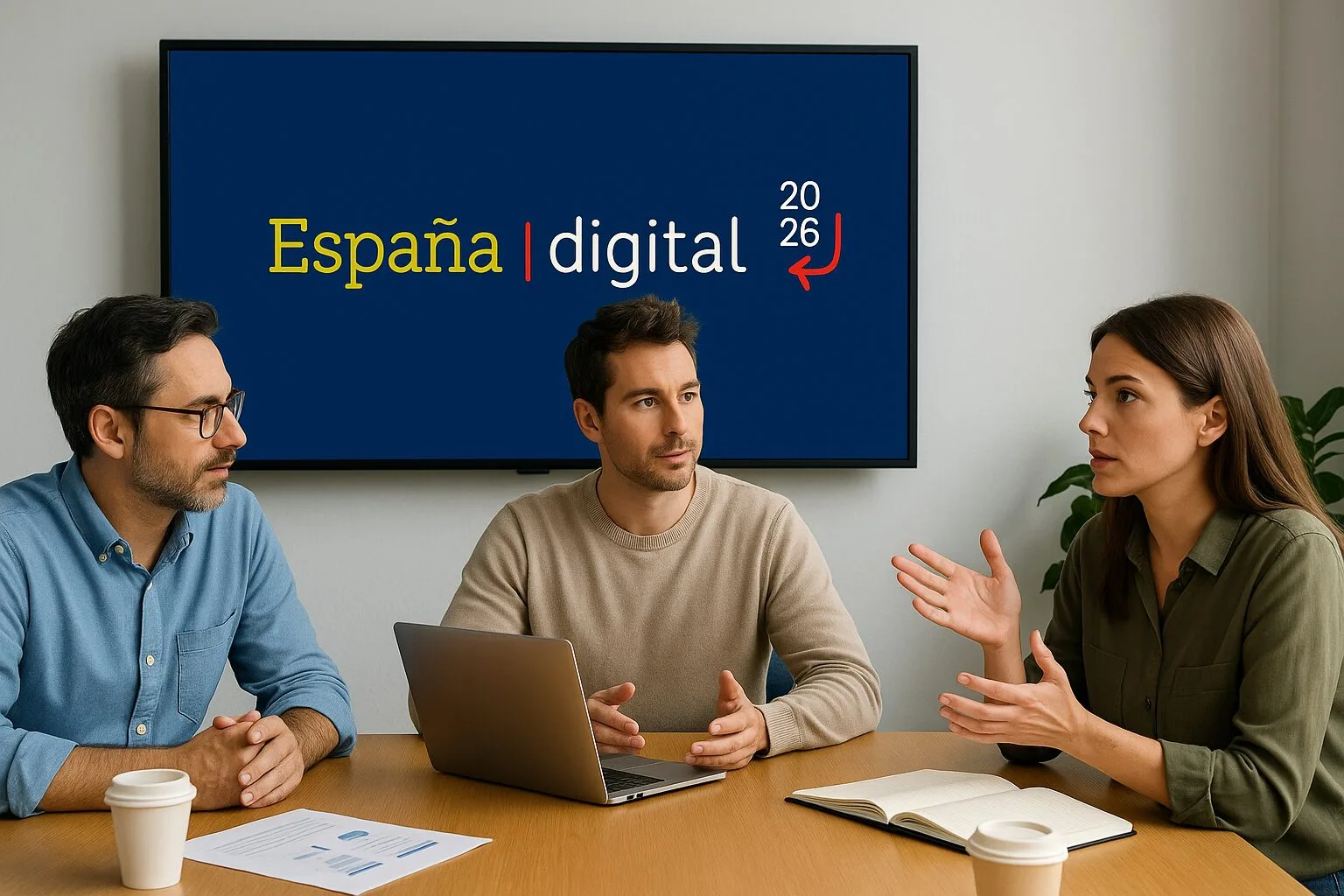
This article uses Digital Spain 2026 as a framework, but brings it down to earth in the form of 5 clear priorities and 7 concrete decisions that you can take in 2026 if you want digitalization, AI, and cybersecurity to work in favor of your business, not against it.
If you run a small or medium-sized business in Spain, Digital Spain 2026 isn't just a distant headline: it influences grants, regulatory requirements, and the types of projects that will be funded. The problem is that the official agenda is written at the national level, while you need to know what to change in your company by 2026 to gain a competitive edge, not just to accumulate more tools and create more noise.
The European Commission and the documents themselves of Digital Spain 2026 They place the current use of AI and big data at around 9–11% of companies, with the goal of reaching around 25% in the coming years.
The SME digitization report of ONTSI It indicates that, although progress is being made, a large part of small and medium-sized enterprises remain at basic or medium levels of digital intensity, with gaps in data, automation and cybersecurity.
According to official figures from Digital Kit,By the end of 2025, more than 860,000 grants had been awarded and billions of euros had been mobilized. The challenge is no longer simply to purchase solutions, but to integrate them into processes that generate profit margins.
We continue with the line of the article published on December 24, where we analyzed the year-end errors in SMEs and institutions. If you haven't read it, it could be a good supplement: 3 year-end mistakes that SMEs and institutions repeat (and how to avoid them before 2026).
We assume this context and focus on the following:
- What does Digital Spain 2026 really say if you look at it with the eyes of an industrial SME, not a ministry?.
- What is the real picture of Spanish companies today, with official data, not perceptions?.
- How to turn all that into 5 management priorities and 7 decisions you can make in 2026.
- Digital Spain 2026 seen from the perspective of an SME
- The real picture of Spanish SMEs in 2025
- Priority 1 · Continuity and cybersecurity before more tools
- Priority 2 · Sort the data before talking about AI
- Priority 3 · Digitize 2–3 key processes, not “the entire company”
- Priority 4 · AI applied with focus and business metrics
- Priority 5 · People and suppliers as leverage (or blockage)
- 7 decisions your SME can make in 2026
- What role can the R&R Route play?
- Frequently Asked Questions (FAQ)
1. Digital Spain 2026 seen from the perspective of an SME
Digital Spain 2026 It is the Government's roadmap for the digital transformation of the country until 2026. It is not just another document: it structures public investments, priorities for aid and requirements that are coming to companies and administrations.
The agenda is structured around several key areas: connectivity and 5G, cybersecurity, the data economy and artificial intelligence, digitalization of SMEs and industry, digitalization of the public sector, digital skills and digital rights, among others. All of that sounds distant if you're managing shifts, orders, and margins on a daily basis.
For an SME, Digital Spain 2026 matters for three very specific reasons:
- It conditions what types of projects receive funding (Digital Kit, new programs for medium-sized businesses, etc.).
- It sets the tone of the future regulation in areas such as data, AI, connectivity, or cybersecurity.
- Define the competitive context: there will be companies in your environment that do use these levers meaningfully and gain an advantage.
You don't need to memorize all ten key areas. What you do need to understand is that Digital Spain 2026 is pushing in a very clear direction: more data, more AI, more security, and more digital capabilities. The question isn't whether you're going to digitize, but how, at what pace, and according to what criteria.
2. The real picture of Spanish SMEs in 2025
Before discussing priorities and decisions, we need to take a cold, hard look at where we are. The reports from ONTSI, from the European Commission and programs such as Accelerate SMEs They paint a clear picture: progress has been made, but not at the pace set by the objectives of Digital Spain 2026.
| SME Reality 2025 | Objectives / Focus Digital Spain 2026 |
|---|---|
| Use of AI and big data around the 9–11% of the companies, According to various European estimates, AI is limited to isolated tests without continuity in many SMEs. | Raise the Business use of AI and big data towards 25%,integrating these capabilities into processes and decision-making, not just in pilots. |
| Level of digitization basic or intermediate In many small and medium-sized enterprises: use of office tools, some cloud computing and digital communications, but weaknesses in data, automation and security. | Consolidate a business network with greater digital intensity, capable of leveraging automation, advanced analytics, and digital channels without relying exclusively on the current provider. |
| Many solutions Digital Kit implemented, but partly underutilized: websites without strategy, CRMs without consistent data, tools that no one has integrated into daily operations. | Take full advantage of the bonuses and aid to redesign processes and gain competitiveness, not just to "check boxes" of digitization. |
| Only about one 27% of SMEs with a solid cybersecurity strategy,According to studies by specialized providers such as Kaspersky, the rest are in partial or risky situations. | Systematically strengthen cybersecurity capabilities in businesses, citizens, and professionals, relying on the national plan and the support of organizations such as INCIBE. |
In summary: The technology is already available and subsidized in many cases,However, the way companies manage, decide, and prioritize doesn't always align with that. That's where your responsibility as a manager comes in.
3. Priority 1 · Continuity and cybersecurity before more tools
The public narrative talks about AI, digital twins, and advanced automation. In practice, the most immediate risk for an industrial SME is much more prosaic: that a security incident halts production, billing, or access to orders for days.
The Spain Digital 2026 plan and the plan itself INCIBE They have strengthened the resources available for cybersecurity, but that doesn't replace internal work. Many recent attacks on small and medium-sized businesses have relied on things as simple as:
- Weak or shared passwords among several people.
- Lack of two-factor authentication on critical access points.
- Backups without real proof of restoration.
- Dependence on a single person or provider to "set up" the systems.
3.1. Direct questions for 2026
Before discussing new digital projects, it's reasonable to answer this honestly:
- If your servers or your ERP system were encrypted tomorrow, do you know how long you would be down and what you would do during those hours or days?
- Do you have backups? disconnected And tested, or do you just trust what the supplier tells you?
- Do access points to corporate email, ERP, and critical tools have two-factor authentication enabled?
- Is there an internal business continuity manager, even if only part-time, or is everything improvised when something goes wrong?
To align with the spirit of Digital Spain 2026, you don't need your own SOC. You do need, at the very least, a clear inventory of critical systems, a proven backup scheme, two-factor authentication where it matters, and an internal manager with visibility into risks and mitigation measures.
4. Priority 2 · Sort the data before talking about AI
Digital Spain 2026 places the data economy and artificial intelligence as a central focus, and explicitly sets targets for increasing the use of AI and big data in businesses. But official data shows that effective adoption is far from what is desired.
In many industrial SMEs, the reality of the data looks more like this:
- Orders distributed between the ERP, emails, and individual spreadsheets.
- Production controlled with "good old" Excel that only the person who set it up understands.
- Incidents and complaints that live in inboxes and WhatsApp groups.
- Commercial forecast based on intuition and historical memory, not on consolidated data.
4.1. What does “ordering the data” really mean?
It's not about setting up a data lake or hiring a data scientist. It's something much more straightforward:
-
Define which data is critical
Orders, delivery times, losses, machine times, incidents, returns, claims, capacity load, sales and purchase forecast. -
Deciding where each piece of data lives
Which system is "the source of truth" for sales, production, quality, and finance? Without duplication, without three versions of the same reality. -
Establish who updates what and how often
Clear roles, not "we'll all do it together". -
Define minimum quality and access standards
Who can modify, how errors are corrected, and what is archived or deleted.
5. Priority 3 · Digitize 2–3 key processes, not “the entire company”
The SME Digitization Plan and programs such as Digital Kit They have driven the adoption of solutions: websites, CRMs, electronic invoicing tools, etc. The problem is that many implementations have remained focused on technology without process redesign.
Practical experience is clear: the companies that have obtained the greatest return are not those that have purchased the most tools, but those that have concentrated their efforts on two or three critical processes and they have transformed them completely.
5.1. Where there is usually the greatest impact on the industry
-
Sales management and offers
Moving from shared Excel spreadsheets and loose budgets to a well-used CRM can change the way you prioritize opportunities, coordinate with production, and anticipate treasury needs. -
Production planning and control
Integrating workload, order status, and actual capacity reduces urgency, rework, and conflicts between departments. -
Incident, non-conformity and complaint management
Registering, classifying, analyzing, and closing the improvement cycle is impossible if everything lives in loose emails.
5.2. How to choose your 2–3 processes for 2026
A reasonable way to choose which processes to attack first:
- List 6–8 key processes (commercial, production, purchasing, logistics, quality, after-sales service…).
- Assess impact on margin, customers and teams (high / medium / low).
- Assess current level of disorder or friction (high / medium / low).
- Choose 2–3 processes with high impact and high disorder, and focus the effort there in 2026–2027.
6. Priority 4 · AI applied with focus and business metrics
Institutional and media discourse has put the AI At the center. Digital Spain 2026 and the National AI Strategy aim for more business projects, more specialized talent and more use of data in key decisions.
On the ground, many SMEs experience something else entirely: demos, promises to automate everything, and pilot projects that never get past the slide.
6.1. What does useful AI mean for an industrial SME?
The AI that matters in 2026 is less spectacular and more concrete:
- Reduce losses in a specific production line, based on historical data and failure patterns.
- Improve the forecast of sales and purchases, to better adjust stock, capacity and treasury.
- Remove administrative hours in standard offers, technical documentation or internal reporting.
- Classify incidents and claims to better prioritize and reduce response times.
6.2. Minimum conditions for an AI project to make sense
- Clear business metrics
Losses, forecast accuracy, administrative working hours, customer response times. - reasonably ordered data
Without structured data, no AI is worthwhile, no matter how good the tool is. - Internal manager with sound judgment
Someone who understands the business process and can decide what makes sense and what doesn't. - Realistic timeframe
6–12 months to see impact, not three weeks of demo.
7. Priority 5 · People and suppliers as leverage (or blockage)
Almost all reports agree on the same thing: the technology is available, but the ability to use and make decisions within companies is lagging behind.
Programs like Digital Generation SMEs The training programs offered by the Acelera Pyme network are specifically designed to raise the digital level of management and middle management. Even so, in many organizations, no one takes on the role of "transformation manager.".
7.1. Three common bottlenecks
-
Saturated direction
People who decide on budget and strategy, but always work at the limit, with hardly any time to reflect or to closely follow digital projects. -
Middle managers without specific training
Key to getting the tools used, but without enough digital skills or space to learn. -
Supplier focused on their catalog, not on your process
The conversation revolves around licenses and functionalities, not around processes, metrics, and impact.
It's not about outsourcing the strategy, but about combining capabilities effectively: leadership that sets priorities, managers who lead concrete changes, and suppliers who help translate the national agenda into very specific processes within your business.
8. 7 decisions your SME can make in 2026
With its five clear priorities, Digital Spain 2026 ceases to be just a PDF and becomes a framework for making choices. Here are seven very specific decisions you can make in 2026 if you run an industrial SME.
1) Appoint an internal digital transformation manager
A Chief Digital Officer (CDO) isn't necessary. All you need is a trusted individual with a broad perspective and direct access to management, who is given the time and clear responsibility to coordinate digital projects and communicate directly with suppliers.
2) Draw a simple map of systems and risks
What systems do you have (ERP, CRM, accounting, MES, industry-specific tools, key Excel spreadsheets), what critical data does each one contain, and what would stop if they failed? That map fits on an A4 sheet and is worth more than many presentations.
3) Choose 2–3 critical processes to fully digitize
Sales/offers, production planning, incidents/quality… Not ten fronts, just two or three, but with numerical objectives and a real commitment to change.
4) Decide which system will be the “source of truth” for each thing
Where can we find the truth about orders, forecasts, production load, and incidents? And where can everyone provide the same information? Without this, no data or AI can hold up.
5) Define 1–2 AI projects with clear business metrics
Reduce losses by 15%, improve forecast accuracy by 10 points, and cut administrative hours in bids by 30%. Metrics, baseline, timeframe, and responsible party—not just “testing AI.”.
6) Block a 2026–2027 budget for structured digitization
It should include licenses, integrations, training, internal hours, and support. A few well-funded projects, instead of many scattered patches.
7) Choose an external support model that gives you more control, not less.
It's not about outsourcing strategic decisions, but about having support to prioritize, organize, and execute effectively. If the provider only talks about their catalog and not your processes, that's a bad sign.
9. What role can the R&R Route play?
Rumbo & Resultados was born precisely from having experienced digital transformation from within: in multinationals, scaleups, industrial SMEs and administrations that have worked with large consulting firms, with impeccable diagnoses that were then difficult to implement in day-to-day operations.
Our R&R Route It is designed to do the opposite: fewer documents that end up in a drawer and more direction applied to processes, data, and concrete decisions.
-
Operational diagnosis
We look at how decisions are actually made and work is done: what processes are hindering margins, what systems are superfluous or lacking, and what risks you are unknowingly accepting. -
Clear and prioritized strategy
A few priorities, well-ordered, with explicit trade-offs. Not a "everything is important" mentality that nobody believes. -
Operational plan and support
Actions, responsible parties, deadlines, and follow-up. No more leaving you with just a PDF and a "we'll be waiting to hear from you.".
In contexts like the current one, we usually start with a specific module: a digitization and data roadmap Aligned with Spain Digital 2026, but written for your reality, your sector, and your size. From there, we decide together how far it makes sense to go (applied AI, process redesign, implementation support, etc.).
If you're interested in exploring how to implement these 5 priorities and 7 decisions in your company, we can schedule a no-obligation exploratory session. This isn't about discussing digital trends, but rather what needs to change in your operations, your data, and your decision-making processes to truly leverage the Spain Digital 2026 context.
10. Frequently Asked Questions (FAQ)
Quick answers to common questions from management teams of industrial SMEs when they encounter Spain Digital 2026 in their daily reality.
Is Spain Digital 2026 not designed only for large companies and public administrations?
No. The agenda sets national objectives, but many of the programs it implements (Digital Kit, SME Acceleration, Digital Generation for SMEs, calls for proposals related to AI and data) are specifically designed for small and medium-sized enterprises. The question is whether you use them to apply band-aids or to address fundamental changes.
Do I need a big digital strategic plan to start moving this forward?
What you need is clarity: five priorities and a few concrete decisions. A short document, with chosen processes, metrics, and a realistic timeline, is usually more useful than an 80-page plan that no one ever reviews.
What if my company is too overwhelmed to take on digital projects?
That's the situation for many industrial SMEs. That's precisely why it makes sense to reduce ambition and increase focus: two key processes, one or two AI projects with clear metrics, and a thorough risk assessment. The goal is to relieve operational strain, not add more burden.
Does this approach also work for B2B service or trading companies?
Yes. The labels change, but the logic is the same: ensure continuity, organize data, choose key processes, apply AI where it makes a difference, and align people and suppliers. The specifics of which processes to target first are tailored to the sector, but the decision-making structure remains the same.
Does Rumbo & Resultados only "make diagnoses" or does it also support the execution?
Diagnosis is only one part of the R&R Roadmap. Our work is meaningful when it translates into decisions, process changes, and supported projects. We prefer fewer PowerPoint presentations and more measurable results in how you sell, how you produce, and how you make decisions.
👉 If you run an industrial SME and recognize yourself in this scenario —bonuses and contracted tools, scattered data, AI projects in pilot and cybersecurity handled with kid gloves— we can help you with something very specific: Turn Digital Spain 2026 into a realistic roadmap for your company, with 2-3 prioritized key processes, 1-2 AI cases with clear ROI and a governable, executable data and security plan without more projects that remain as presentations.
Would you like us to notify you when we publish new content?
We value your time. We'll only send you articles, guides, or tools that help you improve, make better decisions, or take better action.
Our practical resources and online tools

Checklist for managing green infrastructure projects
Evaluate whether your municipality has the necessary capacity to manage and coordinate infrastructure projects

Checklist for citizen communication in the environment
Check in minutes if your municipality effectively communicates its environmental initiatives and succeeds in engaging people

Checklist for green and blue infrastructure strategy
Evaluate in 2 minutes whether your municipality has the necessary foundation to advance in infrastructure

Checklist for operational models of urban green spaces
In just a few minutes, determine if your municipality has a solid operational model for management.