
How we developed the Sant Boi Green and Blue Infrastructure Strategy (2025–2035): from scientific diagnosis to actionable roadmap
Case study · Institutions and territories
Published December 25, 2025 · Category: Strategy · Institutions
In recent years, many city councils have invested in studies on climate, biodiversity, and urban health. The problem is almost never a “lack of reports.” The problem is something else entirely: how to transform all that information into a clear roadmap, with priorities, deadlines, governance, and funding. Sant Boi de Llobregat was exactly at that point when we started this project.
Ten-year strategy, structured in short, medium and long term.
Medium-sized metropolitan city, with very different neighborhoods and realities.
Our work ended with the approval and formal delivery of the Strategy.
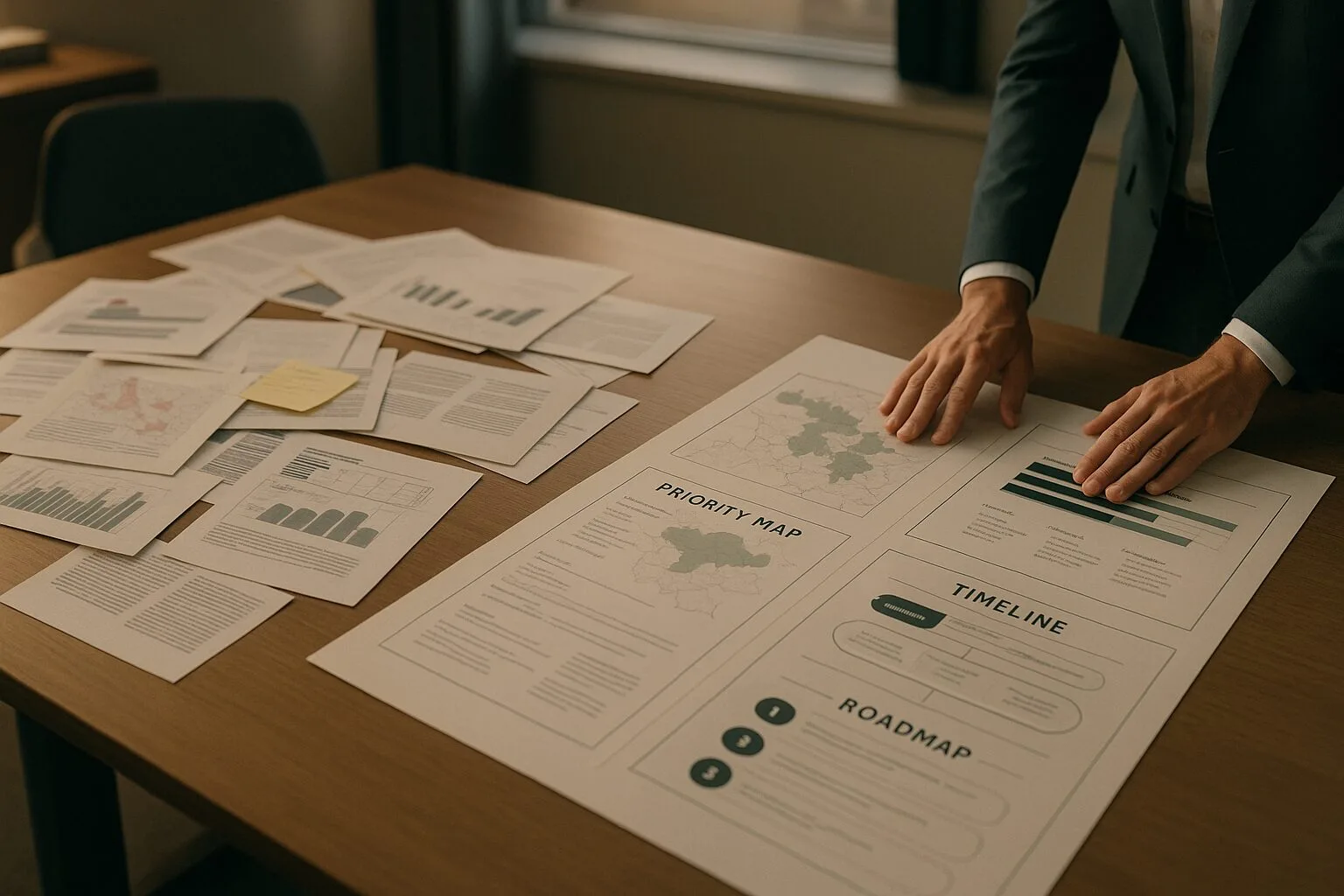
The city already had a solid ecological assessment prepared by CREAF, with maps, indicators, and in-depth analysis of green and blue infrastructure. But that document, as presented, was not usable as a strategy, nor to justify the grants awarded: it did not set ten-year goals, prioritize neighborhoods, define a governance model or a funding scheme, and generated frustration because the City Council still lacked a clear guide to decide what to do first and where to begin.
This case study explains how, starting from that scientific report, we designed the Green and White Infrastructure Strategy of Sant Boi 2025–2035: a document that organizes the information, translates it into municipal management language and proposes a concrete roadmap for the next ten years.
Our work concluded with the formal delivery of the document on August 29, 2025. From that point on, implementation depends on the City Council itself, its political priorities, its technical capacity, and access to funding. This case study illustrates what we did accomplish: transforming a disorganized academic diagnosis into a clear, actionable city strategy that justifies the grant applications.
- The real challenge that Sant Boi faced
- A medium-sized city surrounded by greenery… but with a disconnected core
- From academic report to city plan: the turning point
- What we add about the work of CREAF (and why it makes a difference)
- How the Green and Blue Infrastructure Strategy 2025–2035 is structured
- What does the City Council gain from such a strategy?
- Lessons for other municipalities with “unfinished business”
- What does this case say about the approach of Rumbo & Resultados?
- Frequently Asked Questions (FAQ)
1. The real challenge that Sant Boi faced
The Sant Boi City Council came to this project with an important asset: an extensive ecological diagnosis prepared by CREAF, with maps, indicators and detailed analyses of biodiversity, connectivity and ecosystem services.
The problem was not a lack of information, but rather that, after several rounds of work, the material still had an academic and fragmented logic:
- A great deal of technical depth.
- Of little use as a guide for daily management.
- Difficulty in explaining to elected officials "what we do first", "which neighborhoods come first" and "how we measure if we are making progress".
- Clear 10-year goals (2025–2035) that will set the course.
- Decision criteria by neighborhoods and areas.
- A phased implementation plan: short, medium and long term.
- A governance model: who leads, who coordinates, who executes.
- A financing scheme connected with European funds, supramunicipal programs and own resources.
- A system of indicators and monitoring that is understandable and manageable from the City Council.
In practice, the City Council had a great report, but not a city strategy that could guide municipal action for the next decade.
That's where our work comes in. Starting from that scientific diagnosis, we reorganized all the content around the key attributes of the city's green and blue infrastructure, added the missing socioeconomic and land use context, defined quantified goals for 2035, prioritized actions territorially and temporally, designed the governance and participation model, structured the monitoring indicators, and built a financing and scalability strategy.
In other words, we transformed a valuable but largely unusable document into a Green and Blue Infrastructure Strategy 2025–2035 that the City Council can govern, finance, and implement if it so chooses. This is precisely the kind of work we offer today at Rumbo & Resultados in the strategy and operational plan modules of the R&R Route.
2. A medium-sized city surrounded by greenery… but with a disconnected core
Sant Boi is a medium-sized city in the metropolitan area of Barcelona, with about 85,000 inhabitants and a very particular territorial position:
Territorial context
- Surrounding it are high-value environmental assets: mountain systems, the Agricultural Park and the Llobregat River.
- In the center, a dense urban core, with very different neighborhoods and industrial zones that fragment the territory.
Operational challenge
In this context, the challenge was not simply to “have more green spaces” on the map. The challenge was to design a green and blue infrastructure that would function as a genuine biodiversity system.
- Connecting great natural assets with the daily lives of citizens.
- Reducing the urban heat island effect in densely populated neighborhoods.
- Improving access to quality green spaces where it is most difficult today.
It was also key to integrate Nature-Based Solutions into streets, squares, facilities, school playgrounds, rooftops and productive spaces, aligning this green and blue network with other municipal agendas: health, mobility, local economy, education, citizen participation.
All of this, moreover, with:
- Budgetary pressure.
- Political rhythms typical of any municipality.
- A limited technical structure for managing complex projects.
Designing a green and blue infrastructure strategy in this context is not a theoretical exercise. It is a 10-year public policy decision.
3. From academic report to city plan: the turning point
The starting point was a CREAF report with very robust technical content, but organized with research logic: long chapters, lots of text, detailed methods, tables, maps and annexes.
In internal meetings, the City Council encountered recurring questions:
- “"Okay, so what does this mean for my neighborhood?"”
- “"What do we do next year and what do we leave for later?"”
- “"What part of this can we present to justify European subsidies with guarantees?"”
- “"How do we sell this politically without getting lost in technicalities?"”
That was the turning point. From then on, the work stopped being about "continuing to ask CREAF for more versions of the same document" and became a different task:
- Translate the diagnosis into management language.
- Organize the content so that it can be explained in a one-hour meeting.
- Decision-making: goals, priorities, phases, governance, financing.
That's where Rumbo & Resultados adds value: not by competing with scientific work, but by complementing it with the strategic and operational layer that the city needs.
4. What we add about the work of CREAF (and why it makes a difference)
CREAF's diagnosis was a very good foundation, but it wasn't a strategy. The difference between the two lies in everything that was added afterward. In short, these were the main contributions:
4.1. To establish order and criteria
The first thing was to bring order:
- Reorganize the scattered information around a few clear blocks: territorial context, key attributes of Green and Blue Infrastructure, gaps and opportunities.
- To synthesize conclusions that any elected official or non-specialist technician could understand on a first reading.
- Eliminate redundancies and technicalities that did not contribute to decision-making.
This work of order and synthesis alone completely changes the usefulness of a document.
4.2. Add the missing context
A green and blue infrastructure system is not designed using only ecological data. It must be cross-referenced with:
- Demographics and social vulnerabilities.
- Economic activity and productive fabric.
- Land use and urban dynamics.
Therefore, we added specific sections on population, sociodemographic dynamics and economic activity, which were not developed in the original report and which allow us to decide where it makes the most sense to prioritize certain interventions.
4.3. Define clear 10-year goals (2025–2035)
One of the central elements was translating the diagnosis into concrete ten-year goals, aligned with the reality of the municipality and with European trends:
- Increase the presence of quality green spaces in neighborhoods with the worst starting conditions.
- Increase tree cover in the urban core to reduce heat stress.
- Improve the percentage of the population with access to quality green spaces within walking distance.
- Deploy a certain number of Nature-Based Solutions projects, with a variety of types.
- Integrate Green and Blue Infrastructure into urban planning in a progressive manner.
These goals make the Strategy measurable. It doesn't remain at the level of generic concepts, but rather sets out where we want to be in 2035.
4.4. Prioritize neighborhoods and work phases
It is not possible to act across the entire city at the same time or with the same intensity.
Therefore, the Green Infrastructure Strategy 2025–2035 includes:
- Priority neighborhoods and areas, based on their vulnerability, their lack of green space and their potential impact.
Short term (2025–2027): visible projects, pilot projects, low-cost, high-return actions.
Medium term (2028–2031): Consolidation of green and blue axes, larger-scale projects, changes in public space.
Long term (2032–2035): full integration into planning, structural actions and supra-municipal connections.
This prioritization allows for managing expectations and planning resources.
4.5. Design the governance of the strategy
Governance is by far one of the most frequently overlooked aspects of environmental plans. This plan addresses it head-on. The strategy defines:
- What role does the political team play (leadership, accountability)?.
- What role does the technical team play (cross-functional coordination between areas)?.
- How other actors are incorporated: citizens, entities, companies, educational centers.
- What monitoring and review mechanisms are proposed (commissions, councils, periodic reports).
Without this, any strategy falls apart as soon as conflicts arise over agendas and internal priorities.
4.6. Connect the strategy with the available funding
The other major piece missing from the original document was money. It wasn't enough to say "we need to do more greening." There had to be a response to:
- What financing options might be suitable for each type of project?
- What part can the City Council cover with its own resources and what part needs external support?
- How can European, regional, and metropolitan funding be combined without losing coherence?
The Green and Blue Infrastructure Strategy 2025–2035 incorporates a financing vision that serves as a guide for preparing reports, participating in calls for proposals and structuring projects into viable packages.
| Value-added block | What was done | Practical impact |
|---|---|---|
| Order and criteria | Reorganize, synthesize and refine technical terms from the original diagnosis. | Document understandable by political-technical teams on a first reading. |
| Socioeconomic context | Incorporate population, vulnerabilities, and economic activity. | Prioritize interventions where the social and economic impact is greatest. |
| Goals 2025–2035 | Define quantifiable objectives aligned with European trends. | It allows you to measure progress and justify medium and long-term investments. |
| Prioritization and phases | Organizing neighborhoods and actions in the short, medium and long term. | It provides operational realism and facilitates budget planning. |
| Governance | Define roles, coordination bodies, and monitoring spaces. | It reduces internal blocks and clarifies who does what. |
| Financing | Connect the plan with potential lines of financing. | It increases options for raising funds and justifying grants. |
5. How the Green and Blue Infrastructure Strategy 2025–2035 is structured
The result of all this work is a document that any other municipality could use as a reference, with a clear and logical structure:
Introduction and framework
Why a Green and Blue Infrastructure Strategy? How it connects with other municipal agendas (climate, health, local economy, mobility).
Territorial and socioeconomic context
Sant Boi's position within the metropolitan area. Demographic and socioeconomic overview. Diagnosis of land use and key activities.
Operational diagnosis of the Green and Blue Infrastructure
Key attributes of green and blue infrastructure. Gaps and opportunities, explained in non-technical language.
Vision 2025–2035 and objectives
Where do we want to take the city in terms of green spaces, blue spaces, and urban health? Objectives structured around a few easily understandable axes.
Goals and lines of action
Specific goals for ten years. Types of actions (public space, facilities, roofs, corridors, etc.).
Territorial and temporal prioritization
Which neighborhoods and areas are considered priorities? How is the strategy organized in the short, medium, and long term?.
Governance and participation
Proposed internal structure. Mechanisms for citizen participation and collaboration with other actors.
Financing and viability
Potential funding sources. Criteria for grouping projects and making them eligible for funding opportunities.
Monitoring and review
Key indicators. Monitoring rhythms. Potential times for strategy review and adjustment.
It is not a report for specialists; it is a document intended to be read, debated and used by mixed political-technical teams.
6. What does the City Council gain from such a strategy?
Beyond the technical aspects, the Green and Blue Infrastructure Strategy 2025–2035 provides three very clear benefits for the Sant Boi City Council.
The strategy sets a clear course for ten years:
- What do we want to achieve?.
- Where do we want to act first?.
- What types of projects fit and which ones don't.
This reduces noise, internal doubts, and unproductive discussions.
Green and blue infrastructure ceases to be "isolated projects" and becomes a framework that organizes many pieces:
- Public space projects.
- Health and welfare actions.
- Educational initiatives.
- Actions for local economy and sustainable tourism.
This helps to avoid contradictions (e.g., street reforms that ignore the green strategy) and allows each new project to be evaluated based on whether it adds to or detracts from the whole.
A clear and well-written strategy is a competitive advantage when it comes to:
- Apply for funding opportunities.
- Justify investments to other administrations.
- Explain to the public why some actions are prioritized and not others.
The Green and Blue Infrastructure Strategy 2025–2035 is intended to serve as a foundational document throughout this process.
7. Lessons for other municipalities with “unfinished business”
This case offers several lessons that are repeated in many municipalities:
-
The problem is not always a lack of education.
Often the problem is that existing studies have not been translated into a clear strategic narrative. -
Diagnosis and strategy are different products.
The first one answers "how are we doing?" The second one answers "what are we going to do, when, how, and with what money?". -
Without governance and funding, there is no plan.
If the document only discusses trees, parks, and maps, but not who leads, who coordinates, and where the money comes from, it remains theoretical. -
Good science needs good management.
Centers like CREAF provide enormous value in diagnosis. But if no one translates their results into decisions, the effort is wasted. -
A ten-year strategy is not a rigid snapshot.
It is a framework that allows for adjusting priorities as the political, economic or climatic context changes, as long as there is clarity of goals.
8. What does this case say about the Rumbo & Resultados approach?
This case summarizes well what Rumbo & Resultados does when working with institutions and territories:
- We don't compete with research centers or technical offices. We need them.
In this case, our task begins when the diagnosis already exists and the City Council needs to turn it into a strategy that can be explained, approved, and implemented.
In a case like this, we do three key things:
- Organize and translate information into management language.
- Define goals, priorities, governance and funding.
- Deliver a clear and usable roadmap for several years.
In Sant Boi, our work concluded with the delivery of the Green and Blue Infrastructure Strategy 2025–2035 on August 29, 2025; that is, only the strategy and operational plan modules of the R&R Route were activated. The City Council decides what to activate, when, and with what intensity.
That's important to say because it demonstrates the modularity of our methodology, in which each client chooses the modules that suit their needs, without prejudice to being able to expand them.
In Sant Boi, the modules were activated strategy and operational plan.In other cases, the R&R Route may also incorporate support in the execution (for example, as an environmental Project Manager or strategic support for implementation), always with differentiated tasks and clear objectives.
9. Frequently Asked Questions (FAQ)
Quick answers about what this case study means and how it can inspire other municipalities.
Can we talk about a "success story" if the plan has not yet been fully deployed?
Yes, if we define success correctly. In this case, success isn't "how many projects have been completed," because that phase depends on the City Council. Success is having moved from a largely unusable academic diagnosis to a clear 2025–2035 strategy ready to guide decisions, prioritize projects, and support fundraising.
Does this approach only work for cities the size of Sant Boi?
No. The logic applies to both smaller and larger municipalities. The difference lies in the scale, the level of detail, and the volume of projects, not in the methodology.
Is it mandatory to have a prior report like the one from CREAF to get started?
It's not mandatory, but it helps. If a diagnosis doesn't exist, a minimum information base will need to be built, which the R&R Route can generate without requiring fieldwork like that of CREAF, since it's usually sufficient for an operational diagnosis. But if one already exists (prepared by universities, consulting firms, or internal services), the most efficient approach is usually to leverage and organize it, rather than starting from scratch.
Does Rumbo & Resultados also accompany the execution?
It depends on the project. In Sant Boi, the work was limited to the strategic phase and ended with the delivery of the document. In other cases, we can provide environmental project management or strategic support for implementation, but those are different projects with their own objectives and conditions; that's why the Ruta R&R methodology is modular.
What kind of team does a City Council need to take advantage of such a Green and Blue Infrastructure Strategy?
A large structure isn't necessary, but three minimum things are:
- A political leadership that understands that this is a ten-year policy, not a one-off campaign.
- A technical node that coordinates areas and projects.
- Ability to work across sectors (urban planning, environment, health, services, education, etc.).
👉 If you work in a city council and recognize yourself in this scenario —Solid reports on climate, green spaces, and biodiversity, but without a clear strategy for prioritizing neighborhoods, ordering projects, and accessing funding— we can help you take the next step: turning those diagnoses into a governable, prioritized and bankable Green and Blue Infrastructure Strategy for your municipality, without more documents that end up in a drawer.
Would you like us to notify you when we publish new content?
We value your time. We'll only send you articles, guides, or tools that help you improve, make better decisions, or take better action.
Our practical resources and online tools

Checklist for managing green infrastructure projects
Evaluate whether your municipality has the necessary capacity to manage and coordinate infrastructure projects

Checklist for operational models of urban green spaces
In just a few minutes, determine if your municipality has a solid operational model for management.

Checklist for citizen communication in the environment
Check in minutes if your municipality effectively communicates its environmental initiatives and succeeds in engaging people

Checklist for green and blue infrastructure strategy
Evaluate in 2 minutes whether your municipality has the necessary foundation to advance in infrastructure