
The real obstacle for SMEs in 2025 wasn't AI: it was internal disorganization. Prepare well for 2026.
The data from 2025 makes it clear: the obstacle hasn't been technology, but rather disorder. This is what 2026 demands.
Published December 18, 2025 · Category: Strategy · AI and digitization.
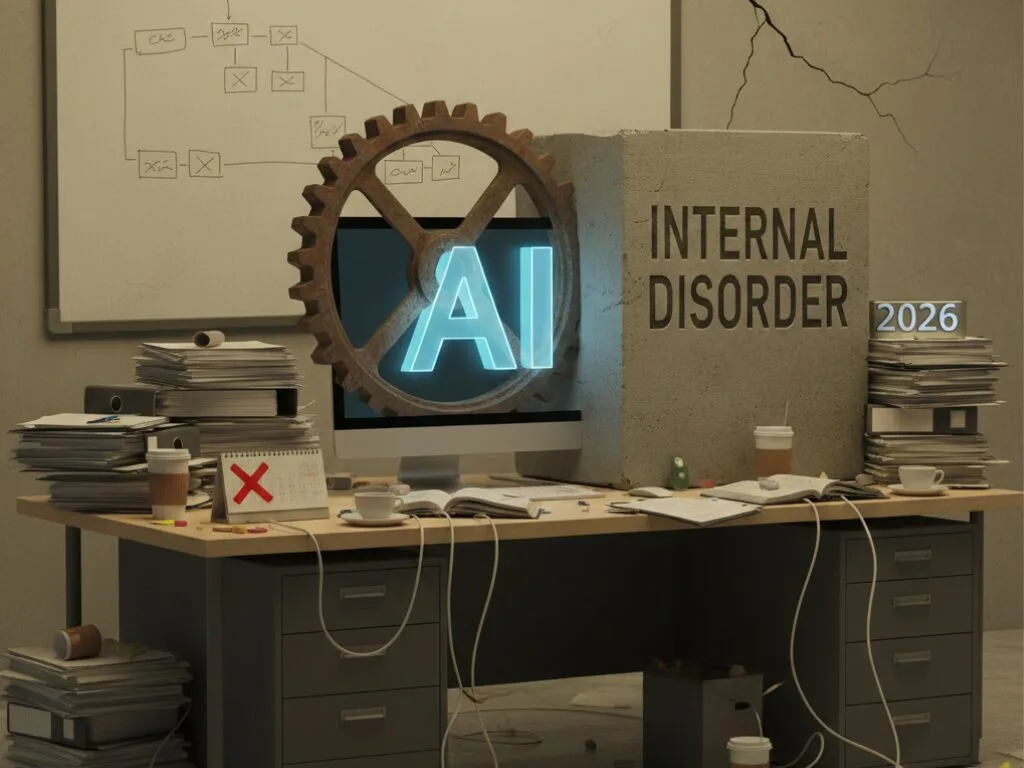
In 2025, the business conversation revolved around generative AI, increasingly powerful models, and the promise of mass automation. But when we look at the realities of SMEs in Spain and the EU, the data points to something else: there hasn't been a lack of technology, but rather a lack of internal order. And what 2026 will demand is precisely that: a clear organizational architecture, less noise, and AI used judiciously, not as a passing fad.
1. Introduction (the slowdown for SMEs in 2025)
Throughout 2025, the business conversation has been completely dominated by artificial intelligence. There has been talk of more powerful models, tools that are updated monthly, automation, agents, and supposed “immediate competitive advantages.”.
However, if we look rigorously at what has happened this year in real SMEs —in Spain and in the EU— the conclusion is different, much more uncomfortable and much clearer:
The companies that have made progress in 2025 have not been those that have used the most AI, but those that have prioritized processes and responsibilities… and then used AI where it really added value.
The latest data confirms this. And what 2026 demands is clear: fewer new tools and more internal architecture. Less hype and more clarity. Less automation for automation's sake and more deciding where AI amplifies what already works and where it corrects a real weakness.
This article summarizes with data what has happened in 2025, what structural obstacles have resurfaced, and why the competitive gap in 2026 will be organizational, not technological.
2. What 2025 has clearly demonstrated: internal disorder remains the biggest competitive drag.
This year's analyses have been conclusive: technology is advancing faster than SMEs' ability to adopt it in an orderly fashion. There's no shortage of tools; what's lacking is coordination between strategy, operations, and people.
Globally, major studies on digital transformation are once again pointing in the same direction. The conclusion is repeated time and again, regardless of the sector: The problem isn't with the software, it's with the internal structure..
1.1. The failure rate of digital transformation remains at 70 %
In 2025, firms like McKinsey, BCG, and Bain, along with various independent reviews, maintain virtually unchanged the figure we've been seeing for over a decade: around 70% of digital transformation projects fail to achieve their objectives. This percentage appears repeatedly in analyses such as This MeltingSpot review explores why digital transformation projects fail. , expanded in This analysis by Mavim on the famous “70 % of failures” and also synthesized in This executive summary on LinkedIn .
The underlying causes have not changed:
- Resistance to change and organizational fatigue.
- Poorly defined or contradictory objectives.
- Lack of clear governance regarding who decides what.
- Operational disorganization and processes that only exist in the minds of a few people.
- Weak organizational culture, with priorities changing every few weeks.
- Vague metrics that do not connect with business results.
- Non-existent or undocumented processes, impossible to improve or automate.
Added to this is a key nuance in 2025: various sources, including Gartner and BCG, estimate that only between 35% and 48% of the technological projects meet or exceed expectations. when they are reviewed under the microscope of real results (revenue, margin, productivity, customer satisfaction, etc.). The rest gets left halfway or ends up shelved.
3. Productivity in Spain: the most revealing data of 2025
If we had to choose a single indicator to understand why so many SMEs have made so little progress by 2025, productivity would be the clearest. And, above all, the comparison with the rest of the European economies. Because here we're not talking about perceptions: we're talking about hard data.
According to the most recent records of Eurostat, Spain has experienced stagnant productivity for years, remaining below the European average. This is confirmed when analyzing productivity per hour worked and the evolution of GDP per worker. And although 2024 and 2025 showed slight improvements in employment and economic activity, productivity levels have not kept pace.
To provide context, the aggregated data from TradingEconomics They show that Spain's productivity has remained within a very narrow range, without any profound structural leaps. And this, for an economy that needs to gain competitiveness and absorb new technologies, is a serious problem.
The Spanish economy has seen some growth in employment and activity, but not in productivity. And when productivity doesn't increase, introducing more technology doesn't generate better results: it simply creates more complexity.
What does this mean for an SME? That even if it incorporates new tools—CRM, automation, generative AI, workflows—the company won't progress any faster if its internal structure remains fragmented. And this is precisely what has happened in 2025: increasing investment in technology, but modest or nonexistent returns.
In daily practice, it has looked like this:
- Oversaturated teams that cannot absorb new tools.
- Processes that do not exist or are not defined, and therefore cannot be automated.
- Departments that do not share information on time.
- Roles that are not clearly defined, which blocks decisions.
- Metrics that are not connected to the reality of the business.
None of these barriers can be solved with AI. They are all structural. And this explains why most digital initiatives have had so little impact by 2025: if the ground isn't level, any new layer just becomes noise.
4. Generative AI in 2025: lots of hype and little ROI when structure is lacking
The dominant narrative in 2025 has been that generative artificial intelligence would rapidly transform any business. The discourse has been full of promises: more productivity, more speed, lower costs, more creativity, and better decisions. But when we land on the real ground of SMEs, the scenario has been much more somber: Without a clear internal structure, AI does not generate ROI.
In fact, several analyses published this year have confirmed something uncomfortable: the companies that have obtained measurable results with AI are not those that have deployed more tools, but those that already had them. operational order. These include industrial sectors, logistics, customer service, and companies with standardized processes and well-defined roles. AI has been most effective where there was prior clarity.
Globally, reports such as the one from Harvard Business Review on the early impact of generative AI or the technological adoption update of McKinsey: State of AI They all agree on the same conclusion: AI generates value when used in repeatable, measurable processes with clear owners. In all other cases, its impact is diffuse or nonexistent.
AI hasn't fixed the mess: it's exposed it. And in many SMEs, it has amplified the lack of focus, the overload, and the internal dispersion.
Throughout 2025, we've seen the same problem repeated in companies of all sizes: AI tool pilots are launched without a defined process, quality standard, clear responsibility, or success criteria. The result is unsurprising: a lot of initial enthusiasm, little real-world use, and no tangible improvement in sales, margin, or productivity.
The most common points of friction this year have been:
- Teams that do not adopt the tool because they do not know when to use it.
- AI-generated content without quality control or editorial criteria.
- Duplicate processes: manual and AI-generated coexisting without coherence.
- Excessive dependence on “experiments” without operational standardization.
- Automations that nobody maintains or understands.
- Executives convinced that “AI is implemented” when the team doesn't actually use it.
And here's the most relevant piece of data of the year: according to various reviews for 2024–2025, less than 25 % Many generative AI initiatives have generated a clear direct ROI. The figure varies by sector, but the pattern is the same: AI multiplies what it finds. If there's clarity, it accelerates. If there's chaos, it only adds noise.
5. The five leaks that have most harmed SMEs in 2025
Looking at the patterns that have repeated themselves time and again this year, there are five main leaks that explain why so many SMEs have invested in tools, AI, and digitization without seeing real results. None of them are technological: they are all structural, managerial, and related to focus.
These are silent leaks: they don't appear on a dashboard and are rarely identified in time. But they are what have made the difference between companies that have progressed by 2025 and companies that remain stagnant.
Priorities that change every few weeks
In many small and medium-sized enterprises (SMEs), the quarter never ends as planned. The urgent overshadows the important. This creates a continuous cycle of strategic shifts, tasks started but not finished, and teams working in "firefighting" mode. The consequence: no sequence, no focus, and no sustained progress. No technology can fix that.
Processes that depend on people, not the company
Most SMEs still operate with processes that are “in the heads” of their key personnel. This creates enormous dependency, hinders continuous improvement, and makes automation impossible. By 2025, it will be clear: if a process isn't standardized, AI won't fix it. It will only add more variability.
Lack of clear governance over decisions
Many companies have adopted new tools without first deciding who governs what. Who defines the standard? Who approves changes? Who validates the use of AI in content, sales, or communication? Without governance, technology becomes a permanent testing ground, and the team works without true alignment.
Metrics that don't explain what's happening in the business
Many SMEs have continued to measure inputs (activity) rather than outputs (results). Dashboards have been created that provide a lot of information but explain little. What 2025 has made clear is that the excess of disorganized data has been more of a hindrance than a help. Without a hierarchy of metrics and leading indicators, sound decision-making is impossible.
Overburdened teams working without any real capacity for improvement
Saturation has been the biggest silent enemy of 2025. When teams are constantly working at their limits, there's no mental space to learn new tools, test new processes, or adopt AI thoughtfully. Saturation turns any progress into noise and any new tool into more burden.
These five leaks have been common in SMEs, growing scaleups, and family businesses. And they all explain why so many AI, digitization, or automation initiatives have had such a low impact. When structure is lacking, technology only amplifies inertia: if there's focus, it accelerates; if there's disorder, it multiplies it.
6. 30-minute R&R test: to detect if the braking was structural
After analyzing more than 200 organizations in recent years, a pattern has emerged with almost surgical precision: when a company isn't growing, the bottleneck is usually in its internal structure, not its technology. To help managers and teams quickly assess where the bottlenecks are, at Rumbo & Resultados we use a quick 30-minute test that indicates whether the obstacle is structural, operational, or related to focus.
No tools required. No reports required. Just clarity. Here's the simplified version.
Define the real goal for the next 90 days
If there isn't a clear and shared objective for the quarter, the company is already operating in reactive mode. 70% of the SMEs we analyzed in 2025 did not have a clearly defined quarterly objective.
Make a list of current initiatives
List all the tasks, projects, campaigns, improvements, experiments, or ideas that are currently underway. Eight out of ten SMEs have between 25 and 60 active initiatives. No one can manage that without friction.
Mark which ones are directly linked to the objective
If less than 30% of initiatives are directly linked to the quarterly target, the problem is one of focus: work is being done, but no progress is being made. This is the most common symptom of the year.
Identify key processes that are not documented
If a key process—sales, customer service, campaigns, reporting, projects—is not documented, it cannot be improved, measured, or automated. This is the root cause of 80% of the operational bottlenecks observed in 2025.
Measure the actual capacity of the equipment
If the team is overwhelmed, there's no possibility of adopting new tools or integrating AI. Overload is the silent enemy of any progress. A team without energy can't manage change.
Check if there is clear governance.
Who decides what gets done and what doesn't? Who validates processes? Who defines quality standards? 60% of the SMEs analyzed in 2025 could not answer these questions without hesitation.
With these six steps, a company obtains an immediate diagnosis of whether its current obstacle is structural (most common), operational (processes that do not work) or simply a lack of focus (excessive initiatives and changing priorities).
7. The three structural disorders that have most hindered SMEs in 2025
After analyzing the patterns that have been repeated in 2025, three structural problems have emerged that explain with unsettling precision why so many SMEs have invested in AI, new tools, and digitization projects without seeing real results. These three obstacles are not dependent on the sector, size, or budget: they depend on the internal management model.
These three disorders are the ones that have most limited productivity, managerial clarity, and the ability to absorb AI with real returns.
Lack of a minimal process architecture
In most SMEs, key processes—sales, campaigns, customer service, reporting, projects—are not explicitly defined. This leads to dependence on specific individuals, operational variability, and a complete block when it comes to automating, measuring, or introducing AI with clear standards.
AI doesn't create order: it needs prior order. And this has been the biggest bottleneck of the year.
Poorly defined roles and responsibilities
2025 has revealed a clear pattern: when responsibilities are unclear, the company slows down. Without clarity on who decides what, who approves changes, or who is accountable for a process, any progress generates friction, duplication of effort, and conflicting decisions.
This problem has been especially critical in companies that have tried to "be more agile" by eliminating layers of coordination... and causing the opposite effect: more noise, more wear and tear and worse execution.
Absence of a hierarchy of metrics connected to the business
Many SMEs have created dashboards overflowing with data, but without a clear hierarchy connecting activity to real results. They lack leading indicators, interpretation criteria, and clear accountability.
In this context, AI doesn't know what to optimize. And neither does the team. Measurement is only useful if it guides decisions. And by 2025, in too many companies, data has generated noise, not clarity.
These three areas of disruption are what separated the SMEs that have progressed in 2025 from those that have stagnated. When these foundations are well-established, AI accelerates everything. When they are not, AI only amplifies the friction.
8. The sequence that did work in 2025 (and will be mandatory in 2026)
After seeing the actual performance of more than a hundred companies this year, there is one pattern that stands out above any technological tool or trend: The companies that have made progress in 2025 have followed a clear sequence.They haven't improvised. They haven't skipped steps. They haven't added AI "just because it's required.".
They have followed a clear, simple, and operational roadmap. And this sequence will be mandatory in 2026 for any SME that wants to generate consistent results.
Bring order: clarify priorities, roles, and objectives
The first step for all the companies that have improved this year has been the same: internal order.Without clear quarterly priorities, defined responsibilities, and aligned metrics, any attempt at digitization becomes just noise. This step has had the greatest impact in 2025.
Document key processes and standardize the basics
Sales, campaigns, customer service, reporting, and projects: if they're not documented, they don't exist. Companies that have made progress this year have standardized the essentials first. This has allowed them to improve, assign real responsibilities, and lay the groundwork for meaningful automation.
Apply AI only where there is already order and visible return.
When the structure is clear, AI ceases to be “magic” and becomes an accelerator. Companies that have achieved a return on investment by 2025 have applied AI only to repetitive, standardized processes with measurable results: content with editorial criteria, simple automations, recurring analyses, or low-variability operational tasks.
Assign clear responsibilities and measure weekly.
The difference between companies that move forward and companies that stagnate is the discipline of monitoring. It's not about creating endless dashboards, but about reviewing what matters weekly. What's moving forward? What's blocking things? What do we need to adjust? This has been the core of the teams that have been successful this year.
Adjust every 30 days and consolidate every 90.
2025 has made it clear: quarterly reviews are no longer negotiable. Companies that have gained momentum have operated on 30–90 day cycles: monthly operational adjustments and quarterly strategic consolidation. This pace will be the norm in 2026, not the exception.
This sequence—order > processes > applied AI > responsible parties > monitoring—has been the common pattern for all companies that have generated real growth by 2025. None have achieved this by skipping steps. None have progressed by placing AI on top of chaos.
9. What 2026 requires: internal architecture + AI applied with sound judgment
If 2025 was the year of enthusiasm and the chaotic testing of AI tools, 2026 will be the year where reality will prevail: The competitive advantage will not come from having more tools, but from having more order.. AI will be a multiplier, but only for companies that enter the year with clear processes, defined roles, and well-established priorities.
The strategic and operational analyses we are conducting already indicate a profound shift: less experimentation, fewer "toys," less hype, and more solid application criteria. The best-performing companies are making decisions based on three principles that will be crucial in 2026.
AI only works if the processes are well defined
Next year, the award will not go to those who experiment the most, but to those who document, simplify, and refine their processes. Without standards, any AI system generates variability and ends up adding more review tasks than real value.
Governance will be as important as technology
Companies that haven't clarified who validates AI-generated content, who defines quality criteria, or who decides what to automate have wasted weeks—or even months—in unproductive debates. By 2026, clear governance will be a barrier to entry for competitiveness.
Fewer tools, more real adoption
The SMEs that have made the most progress this year haven't had more software: they've had better adoption. Less fragmentation, less duplication, less trial and error. In 2026, the winners will be those who use a few tools, well integrated, well governed, and well adopted by the team.
Everything points to 2026 being a year of natural selection: SMEs with internal order and strategic focus will be able to apply AI with vision, move forward quickly, and make more sound decisions. Those that enter the year in disarray will remain overwhelmed, scattered, and without a clear path forward.
The leap won't be technological, it will be organizational. AI will be relevant, yes. But only for those who enter the year with an internal architecture capable of supporting it.
10. Conclusion: the real leap is not technological, it is organizational
What 2025 has made clear, through data and direct experience with real SMEs, is that the problem hasn't been AI. It's been internal disorganization: blurred priorities, nonexistent processes, poorly defined roles, and decisions that change every week. In that environment, AI doesn't fix anything. It only amplifies the chaos.
In contrast, the companies that have made progress share a common pattern: order before automation. They have used AI to amplify their strengths, not as a band-aid for their weaknesses. They have applied sound judgment, simplified processes, documented everything, and created an internal architecture that ensures each new tool has a place, a purpose, and an owner.
2026 will not reward those with the most tools, but those with the structure that allows AI to be turned into real results.
That's the difference between experimenting and moving forward. Between testing and consolidating. Between accumulating automations without impact… and building a model capable of making better decisions, reducing noise, and accelerating meaningfully.
That is exactly the approach we advocate at Rumbo & ResultadosStrategic clarity, operational order, and an AI application that generates returns, not noise. A model based on a simple principle: Technology only multiplies what is already ordered..
Frequently asked questions about AI, structure and SMEs
Clear and direct answers to the most frequently asked questions when an SME wants to introduce AI, but suspects —rightly so— that its organizational structure is not yet ready.
Does it make sense to use AI if my company's processes are "in their infancy"?
Yes, as long as you do it in very specific use cases And with realistic expectations. Start with focused tasks: summarizing long meetings, improving proposals, generating content drafts, or preparing quick analyses.
What doesn't work is trying to get AI to fix messy processes or a complete lack of priorities. It only amplifies the chaos.
Do I need an “AI team” or a Chief AI Officer?
In a small business, almost never. What you do need is that management and middle management They should be clear about what AI will be used for, what decisions it affects, and what quality criteria should be applied.
You can have a technical reference person, but the responsibility is business-related: sales, marketing, operations.
How do I prevent AI from becoming just another passing fad?
The key is to link each AI initiative to clear objectives, metrics, and responsible parties. If you don't see an impact on real indicators within three months, you stop, adjust, or change your approach. AI should be subject to the same discipline as any other investment.
What do I do if the team is afraid that AI will replace their jobs?
It's normal. The best way to eliminate that fear is to use AI first to remove repetitive tasks, not to cut jobs or control anyone.
When the team sees that AI saves them tedious work and allows them to focus on more impactful tasks, adoption becomes natural.
Where do I begin if everything seems too big right now?
Start with the checklist in section 6 and be completely honest in your answers. Then choose just one process, not five: for example, improving sales proposals.
Define a specific use case: what you want to improve, who is leading the process, and how you will measure it. Once it's working, extend it to another area. That's the realistic approach.
👉 If you run an SME and recognize yourself in this scenario, we can help you get organized before accelerating: Clarify priorities, structure processes, and apply AI where it has a real impact —without noise, without improvisation, and without adding more useless tools.
Would you like us to notify you when we publish new content?
We value your time. We'll only send you articles, guides, or tools that help you improve, make better decisions, or take better action.
Our practical resources and online tools

Checklist for citizen communication in the environment
Check in minutes if your municipality effectively communicates its environmental initiatives and succeeds in engaging people

Checklist for green and blue infrastructure strategy
Evaluate in 2 minutes whether your municipality has the necessary foundation to advance in infrastructure

Checklist for managing green infrastructure projects
Evaluate whether your municipality has the necessary capacity to manage and coordinate infrastructure projects

Checklist for operational models of urban green spaces
In just a few minutes, determine if your municipality has a solid operational model for management.