
Artificial intelligence tools that are truly useful for SMEs
How to choose the AI tools that truly add value to a small or medium-sized business, without getting caught up in the noise or impossible promises.
Published November 20, 2025 · Category: Strategy · AI and digitization.
- What do we mean by AI that is truly useful for an SME?
- The three layers of tools you do need to understand
- Common ailments that AI can alleviate
- Criteria for choosing without falling into the trap of "glitter"“
- Tools that reduce operational load
- Tools that improve sales, marketing, and customer service
- Tools that organize information, reporting, and control
- How to adapt the stack according to the size of your company
- Closing: Technology that works for your SME
1. What do we mean by AI that is truly useful for an SME?
Effective AI isn't the kind that impresses in a demo, but the kind that fits seamlessly into your business routine. It serves three very specific purposes: reducing manual work, improving data visibility, and helping you make better decisions.
A small or medium-sized business needs visible results in less than a month. That's why the value of AI is measured by what it unlocks, not by what it promises.
In a small company, a good AI tool doesn't replace anyone: frees up operating time. In a median, connects departments and processes. In both cases, it allows you to dedicate more energy to the customer and less to repetitive tasks.
2. The three layers of tools you do need to understand
For many SMEs, AI still sounds abstract. If we break it down into three layers, each piece finds its place and we better understand what each one does within the business's digital system.
1️⃣ Real AI (the one that thinks or generates)
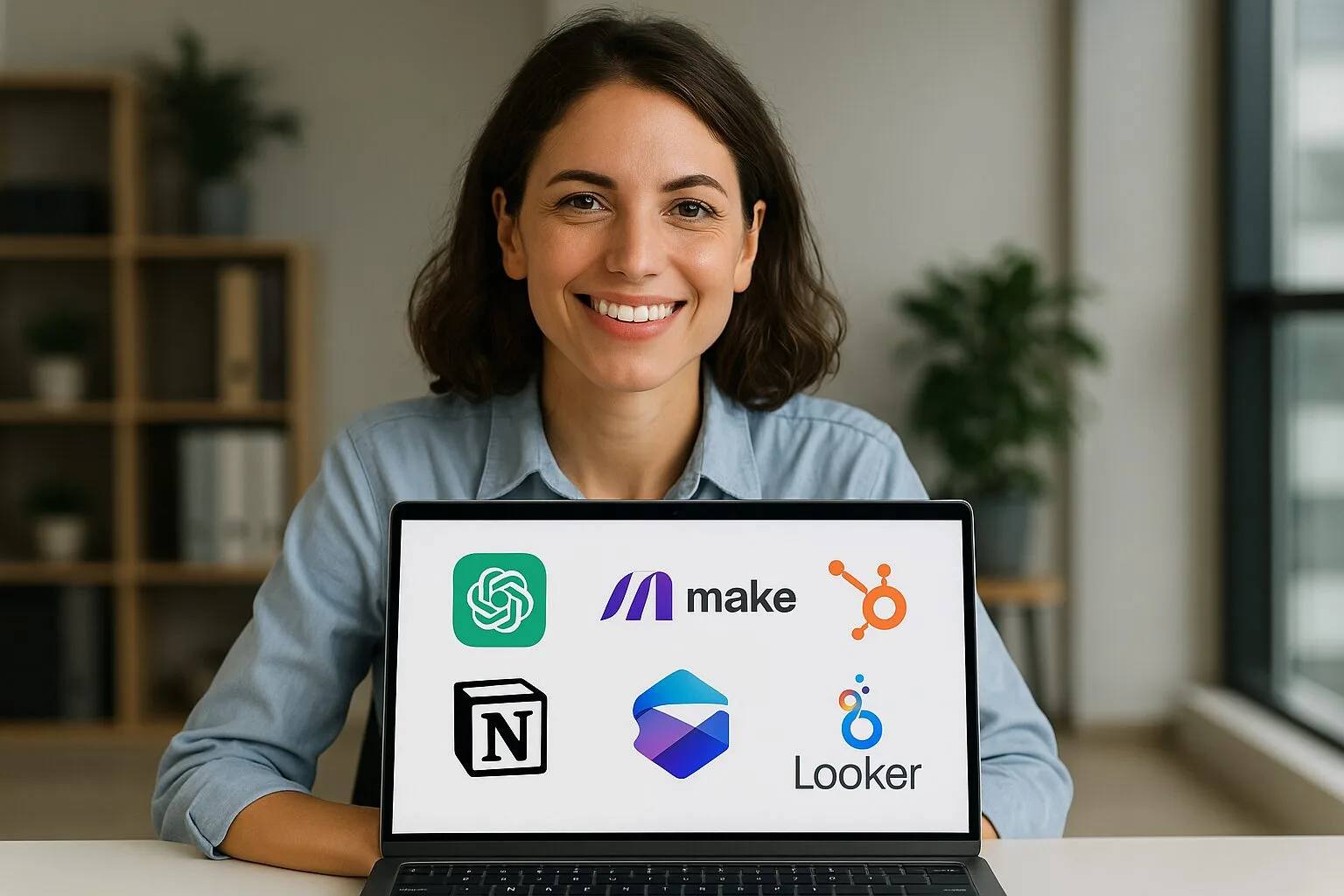
It is the one that interprets, writes, predicts, or analyzes using trained models. Examples: ChatGPT, Claude, Gemini, Microsoft Copilot o Notion AI.They allow you to write emails, summarize documents, analyze data, or convert ideas into usable text.
- When to use it: when you need to create or summarize information, or standardize messages.
- Advantage: It speeds up tasks that previously took hours.
- Risk: Without its own context, it can generate generic responses.
2️⃣ SaaS with integrated AI (the one that automates and decides)
These are platforms that integrate AI into already known processes: HubSpot, Make, Zapier, ClickUp, AI-powered Typeform, among others.
- They connect tools (for example, web forms with CRM).
- They assign automatic priorities in sales.
- They transform data into alerts or reports without human intervention.
Advantage: You take advantage of AI without programming. Common danger: Don't try to automate everything at once; start with one workflow and consolidate.
3️⃣ Basic tools without AI (the one that supports everything above)
They neither generate nor predict, but they are essential: Google Sheets, Docs, Drive, Looker Studio, Power BI, etc.
- They provide order and traceability.
- They provide a place where AI can work with reliable data.
- They allow sharing, measuring, and making informed decisions.
One layer creates (real AI), another connect (SaaS with AI) and another orders (base). Without structure, AI becomes an expensive experiment.
3. Common ailments that AI can alleviate
Most SMEs suffer from the same obstacles: excessive manual work, disorganization, external dependence, and poor visibility of results.
- Operational overload: Too many small, low-value tasks.
- Chaotic trade tracking: lost leads, unanswered emails.
- Scattered documentation: Different versions, time wasted searching.
- Inconsistent reporting: decisions based on intuition, not data.
- Dependence on consulting firms: lack of autonomy for basic tasks.
In all these cases, the pattern repeats itself: a lot of work is done, but without a system that learns from that effort. AI isn't here to perform magic; it's here to bring order to the chaos.
4. Criteria for choosing without falling into the trap of "glitter"“
Tech trends change every quarter. The important thing isn't to be "up-to-date," but to use what works for you today. Before trying any tool, run it through this filter:
- Does it reduce actual tasks or just add steps?
- Can you use it tomorrow without depending on anyone?
- Does it fit with your email, your CRM, and your way of working?
- Do you respect your customers' privacy and data?
- Is it cost-effective in the long run?
Common mistake: confusing testing with adoption. Many SMEs test ten tools, get excited for two weeks, and don't stick with any of them. The value lies not in testing, but in... integrate: choose one, master it and connect it with the others.
5. Artificial intelligence tools that reduce operational load
The hours lost on administrative tasks are the invisible cost for many SMEs. These tools allow you to recover that time in just a few weeks.
ChatGPT Team / Enterprise
- Write emails, summaries, and proposals based on your instructions.
- Create standard documentation using examples from your own company.
- Analyze lists or transcripts and propose improvements without changing formulas.
Microsoft Copilot / Google Gemini
- They integrate AI into Word, Excel, Outlook, Gmail or Docs.
- They generate automatic reports and explain data in natural language.
Make / Zapier
- They connect applications without code.
- They automate reports, notifications, data backups, and repetitive tasks.
A store with 10 employees automates the sending of sales reports: Make connects the POS system to Sheets, ChatGPT summarizes the results, and the report is automatically generated and sent every Monday. This allows the manager and sales staff to focus on restocking properly and providing dedicated customer service.
A consulting firm that manages dozens of clients uses Copilot to generate weekly summaries of pending tasks and ChatGPT to prepare personalized emails before the fiscal year-end. Less workload, more focus, and fewer repeated errors.
6. Tools that improve sales, marketing, and customer service
Here, AI does not replace people, but rather strengthens the relationship with the customer and reduces time wasted on repetitive business tasks.
HubSpot Free / Starter with AI
- Automatically register leads from forms and emails.
- Automate follow-up emails and task reminders.
- Use AI to summarize calls and prioritize opportunities.
Notion AI / ClickUp AI
- They write proposals, presentations, or business reports.
- They standardize tone and format for the entire team.
ChatGPT / Jasper / Writesonic
- They generate marketing texts, product descriptions, and campaign messages.
- They allow you to train your style with real examples from the brand.
An industrial distributor uses ChatGPT to draft customized proposals, saves them in Notion with version control, and manages follow-up from HubSpot. Less duplication, more business clarity.
A clinic or small hotel uses ChatGPT for welcome messages, review responses, and appointment reminders. The team spends more time on customer service and less time writing from scratch.
7. Tools that organize information, reporting and control
AI cannot provide clarity if the data is disorganized. These tools create the necessary structure for making informed decisions.
Google Sheets + ChatGPT / Copilot
- They generate automatic summaries and alerts on key metrics.
- They explain monthly variations without complex formulas.
Looker Studio / Power BI
- They connect sales, costs, and pipeline in clear dashboards.
- They allow you to review the business with data every week.
Notion / Coda
- They unify documentation, tasks, manuals, and processes.
- They centralize incidents and protocols accessible to the entire team.
An industrial maintenance company records work orders in Notion; Make sends the data to Sheets; Copilot summarizes incidents, and Looker Studio displays average resolution times. Fewer emails, more operational control.
8. How to adapt the stack according to the size of your company
Every size of company has a different level of digital maturity. The key is not to accumulate tools, but to coordinate the right ones.
Micro-enterprise (1–5 employees)
Aim: free up time and reduce errors.
- ChatGPT Team.
- Google Workspace or Microsoft 365 with AI.
- Make / Zapier for simple automations.
- Notion AI for documentation and templates.
Expected result: Fewer repetitive tasks; more time to sell and serve customers.
Growing SME (10–50 employees)
Aim: unify marketing, sales, and reporting.
- ChatGPT Team / Copilot.
- HubSpot Free / Starter with AI.
- ClickUp / Notion AI.
- Looker Studio connected to Sheets.
- Make as the backbone of integrations.
Expected result: connected processes, automatic reporting, and control over the sales funnel.
Consolidated medium-sized (50–200 employees)
Aim: govern processes and data.
- ChatGPT Enterprise + Copilot.
- HubSpot Professional or Zoho CRM with AI.
- Power BI or Looker Studio.
- Notion / Confluence with AI for internal knowledge.
- Make / Power Automate for advanced workflows.
Expected result: data-driven decisions, standardized reporting, and less reliance on consulting firms.
Table 1 · Pain, tool and impact logic
| Pain or habitual stagnation | Tool / solution | Ideal segment | Guy | Reason and logic of impact |
|---|---|---|---|---|
| 1. Overload of repetitive tasks (emails, reports, minutes, internal texts) | ChatGPT (Team / Enterprise) o Microsoft Copilot | All (from micro to medium) | real AI | Generate and summarize operational content; save hours without relying on third parties. |
| Make / Zapier | Micro-enterprise / Growing SME | Hybrid | Automate sending, notifications, and data transfers between apps without code. | |
| 2. Lack of sales follow-up or chaotic pipeline | HubSpot Free / Starter with AI | Growing SME / Medium | Hybrid | Centralize leads, automate emails and reminders; AI suggests follow-ups and prioritizes opportunities. |
| ChatGPT + Sheets (Apps Script) | Micro-enterprise / SME | AI real + base | Register contacts and generate sales reports without expensive CRM. | |
| 3. Scattered documentation and uncontrolled proposals | Notion AI / ClickUp AI | All | real AI | Standardize templates, proposals, minutes, and manuals with contextual AI. |
| 4. Lack of reporting or control of indicators | Google Sheets + ChatGPT / Copilot / Gemini | All | AI real + base | Summarizes data and generates automatic conclusions; connects with dashboards. |
| Looker Studio / Power BI | SME / Medium | Base | Visualize key metrics with traceability for management. | |
| 5. Manual processes between departments (orders, incidents, HR) | Make / Power Automate | SME / Medium | Hybrid | Orchestrates workflows between ERP, CRM, forms, and email; avoids duplicate tasks. |
| 6. Disorganized internal communication | Slack / Teams + AI bots | Median | Hybrid | Generates meeting summaries, reminders, and automatic notifications. |
| 7. Lack of time to create content and marketing | ChatGPT / Jasper / Writesonic | Micro-enterprise / SME | real AI | Generate commercial texts, posts or emails adapted to tone and objectives. |
| 8. Lack of a method for capturing and classifying information | Tally/Typeform + Make + Integrated AI | Micro-enterprise / SME | Hybrid | Turn forms into actionable data or automated tasks. |
| 9. Chaos in document management and permits | Google Drive / Notion + Integrated AI | SME / Medium | AI real + base | Create a single information hub with semantic search and version control. |
| 10. Dependence on external consultants for basic tasks | Minimum R&R stack: ChatGPT + HubSpot + Make + Sheets + Looker Studio | SME / Medium | Mixed | It covers analysis, communication, and reporting without rigid external structures. |
Table 2 · Focus by company size
| Segment | Operational objective | Stack focus | Expected return |
|---|---|---|---|
| Micro-enterprise (1–5 employees) | Free up time and organize what's essential | ChatGPT / Make / Google Workspace / Notion AI | +4 hours/day recovered and less external dependence. |
| Growing SMEs (10–50) | Unify marketing, sales, and reporting | HubSpot + ClickUp AI + Copilot + Looker Studio | Pipeline control, margin visibility, and reduction of manual tasks. |
| Consolidated median (50–200) | Govern internal processes and data | ChatGPT Enterprise / Power BI / Copilot / HubSpot Pro / Make | Less reliance on consultants, data-driven decisions, and standardized reporting. |
9. Closing: Technology that works for your SME
Artificial intelligence won't replace management, but it can give it meaning. A small or medium-sized enterprise (SME) that operates with order, data, and digital discipline can use AI for what truly matters: producing more with less noise.
If an SME consistently applies these tools for a year, the return is tangible: hundreds of hours freed up, more informed decisions, and less dependence on external providers. AI isn't a leap, it's an evolution. Those who apply it judiciously will gain margin, agility, and control.
Recommended source: ONTSI – Digital maturity diagnosis of Spanish SMEs, 2024 .
Schedule a quick session and we'll help you build your minimum efficient stack: the set of tools that truly aligns your day-to-day work with your business goals.
View Advanced Digital Strategy and Applied AI service
From Rumbo & Resultados We assist private companies in designing and implementing their digital and applied AI strategy, focusing on real productivity and operational simplicity.
Frequently Asked Questions
Quick answers to implement without losing focus on real results.
Do I need technical knowledge to use these tools?
No. All of them can be used with basic training. The important thing is to define which process to automate, document how it's done now, and periodically check that the automation is still working.
How much does a basic AI stack for SMEs cost?
It depends on the size and combination, but it usually ranges from €0 to €70 per user per month. Many tools (ChatGPT, HubSpot, Make) offer free or trial plans sufficient to validate your needs without risk before upgrading.
Can I use AI if I handle sensitive customer data?
Yes, provided you work with GDPR-compliant providers, properly configure privacy settings, and avoid sending personal data to uncontracted public services. When dealing with sensitive information, prioritize enterprise environments and clear access policies.
What is the difference between generative and productive AI?
Generative AI creates text, images, or code. Productive AI focuses on automating tasks, summarizing, connecting systems, and generating a direct return in time and money. A small or medium-sized enterprise (SME) primarily needs the latter, while relying on the former.
Where do I start if I've never used AI in my company?
Identify three repetitive tasks: reports, template emails, and lists. Test them with ChatGPT or Copilot, measure the time saved, and document the workflow. From there, integrate tools like HubSpot or Make for stable automation.
👉 If you run an SME and recognize yourself in this map, we can help you move from the noise about AI to a A specific stack of tools that automates repetitive tasks, organizes your data, and leaves you more time to do business.
Would you like us to notify you when we publish new content?
We value your time. We'll only send you articles, guides, or tools that help you improve, make better decisions, or take better action.
Our practical resources and online tools

Checklist for operational models of urban green spaces
In just a few minutes, determine if your municipality has a solid operational model for management.

Checklist for green and blue infrastructure strategy
Evaluate in 2 minutes whether your municipality has the necessary foundation to advance in infrastructure

Checklist for citizen communication in the environment
Check in minutes if your municipality effectively communicates its environmental initiatives and succeeds in engaging people

Checklist for managing green infrastructure projects
Evaluate whether your municipality has the necessary capacity to manage and coordinate infrastructure projects