
- Spanish SMEs are still in very early stages of AI adoption: between 10% and 20% they reported using it, but most only in tests or pilots without scaling up.
- The main obstacles are not technical: the real blockage is in diffuse ROI, disorganized data and an organizational culture without a clear person in charge.
- Ignoring AI means losing speed, margin, and talent to competitors who are already automating tasks, reducing costs, and accelerating their time to market.
- The practical path for an SME does not lie in large projects, but in pilots with watches, Defined KPIs and a progressive scaling plan.
- ROI is quantifiable with simple formulas applied to specific cases: customer service, sales, billing, operations or back-office.
Artificial intelligence is not just a trend. According to the McKinsey Global Institute , generative AI could add up to $4.4 trillion annually to global GDP thanks to the direct impact on productivity and efficiency.
1. Why SMEs cannot ignore AI
During 2024–2025, the artificial intelligence adoption gap has become more evident in Spain.
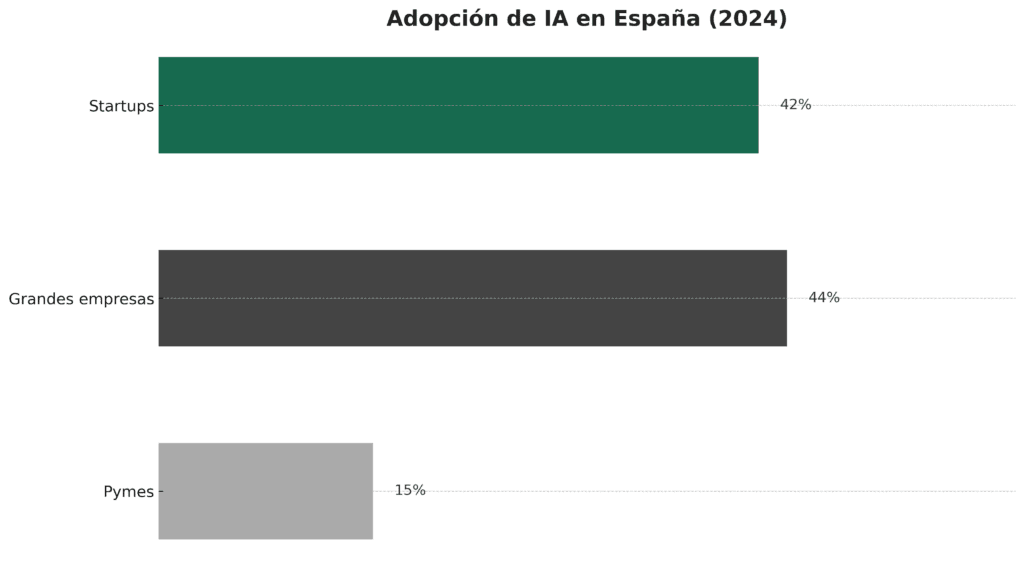
- According to Eurostat , In 2024, only the 11.4% of Spanish companies with more than 10 employees claimed to use artificial intelligence, compared to approximately one 44% in large companies. Most SMEs remain in pilot testing phases, without integrating it systematically.
- Meanwhile, similarly sized competitors are already using AI to reduce costs, accelerate sales and improve customer experience.
- In Spain, the digitalization of SMEs is an explicit public policy objective. SME Digitalization Plan 2021–2025 It positions the adoption of advanced technologies, including AI, as a key element to improve competitiveness and resilience.
👉 This makes AI a matter of strategic survivalIt's not about having it "just because," but about applying it judiciously to generate measurable return.
The gap between startups and large companies
- The digital startups They already incorporate AI into products, marketing and operations; many are born with this DNA.
- The large companies They have budgets, consultants, and internal departments to move forward.
- The SME is in the middle: neither abundant resources nor a solid technological base, but with increasing competitive pressure.
What does it mean to talk about ROI in AI?
For an SME, AI only makes sense if it translates into clear economic results and comparable with other business investments:
- Saving working hours (administrative automation, support, reporting).
- More income (faster sales, better conversion, better prioritized offers).
- Fewer errors and avoided costs (billing, stock, claims, penalties).
👉 Pocket formula:
ROI ≈ (Hours saved × cost per hour + additional € in sales + € costs avoided − investment) ÷ investment
If you want to translate this formula into concrete numbers without struggling with spreadsheets from scratch, you can use the Basic ROI calculator from Rumbo & Resultados, designed for digitization and AI projects in SMEs.
2. Pain points that block companies
Although many SMEs have already heard about AI and even conducted tests, most encounter obstacles that turn these attempts into failures. “perpetual pilots” without real impact. These are the most common obstacles that hinder ROI and effective adoption.
Diffuse ROI: projects that do not achieve results
- Tools are tested because they're fashionable, without prioritized use cases neither clear KPIs.
- A business mini-metric is missing that answers the question: “What do I earn in € for this pilot?”
- Without that foundation, the project dies or remains an isolated experiment, without going into production or scaling up.
| Problem | Typical example | Consequence |
|---|---|---|
| diffuse ROI | It does not define what specific benefits are expected. | It is difficult to justify continued or future investment |
| Poor data | Incomplete, disorganized, or unlabeled data | Model with low performance or unreliable results |
| Lack of owner | No one is taking responsibility for the project | The pilot gets stuck or gives up |
| Costs | The project requires more resources than anticipated. | The pilot project is ruled out due to lack of viability |
| Technological Lock-in | Dependence on a vendor or closed platform | Difficulty scaling or migrating the solution |
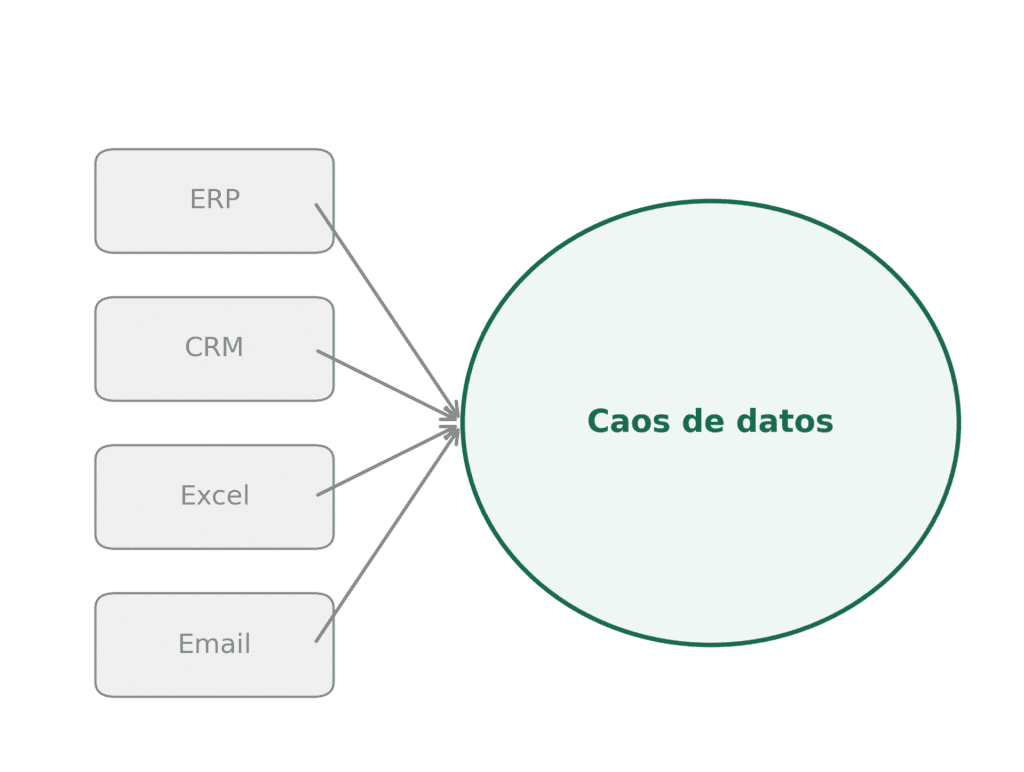
Data chaos
- Data scattered across ERP, CRM, and outdated Excel spreadsheets.
- Low quality: duplicates, errors, incomplete histories.
- Fear of non-compliance with regulations (GDPR) due to not knowing how to govern them.
People and culture
- Lack of profiles with a minimum base of analytics and automation.
- Internal resistance: fear of being "replaced" or of changing routines.
- Nobody assumes the role of AI owner in the business.
Costs and supplier dependence
- Perception that AI is expensive and only accessible to large companies.
- Fear of lock-in: getting stuck with a tool or provider.
Technology and regulation
- Integration with legacy systems (ERP, POS, field service).
- Security risks (data leaks, unsafe prompts).
- Doubts about the European AI Act: what applies, when and in what use cases it can be considered “high risk”.
3. What happens if you miss the AI train?
In a small or medium-sized enterprise (SME), not adopting AI in time It's not just losing efficiency: it's letting your competitors gain speed, reduce costs, and attract better talent. The differences start to become noticeable in less than 12–24 months.
Faster and cheaper competition
- Similar companies are already reducing the cost per task with virtual assistants, automatic document extraction, and demand forecasting.
- This allows them sell cheaper or invest more in marketing, while your SME continues with manual processes.
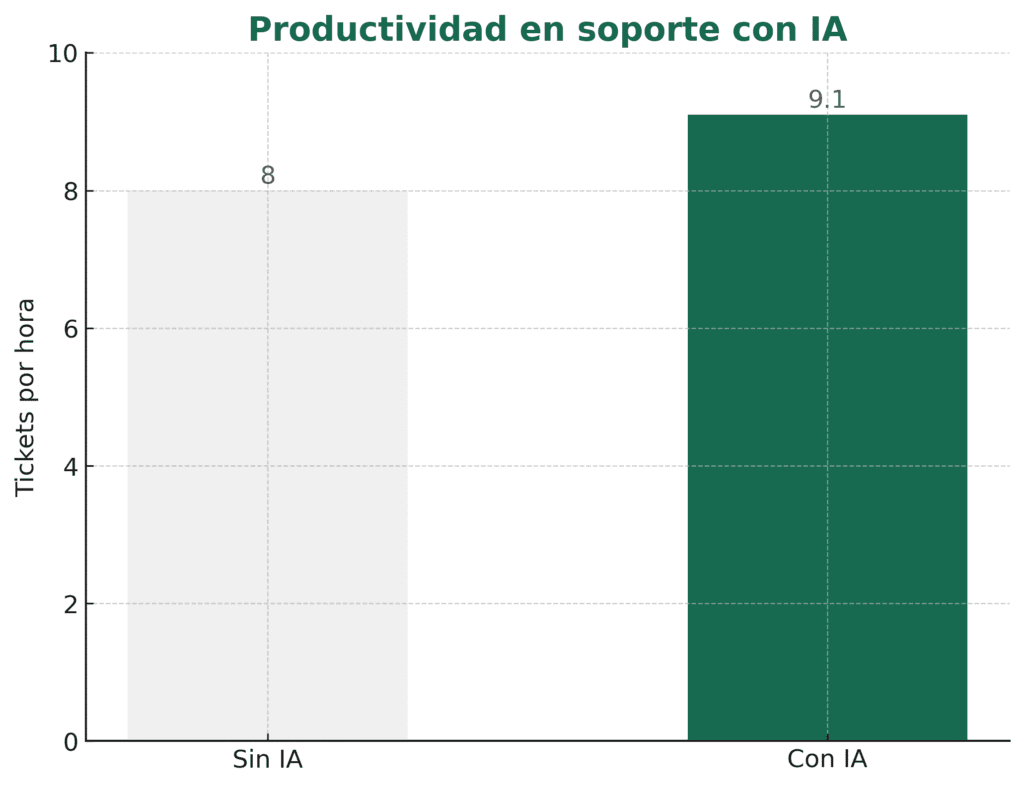
| Metrics | Without AI | With AI |
|---|---|---|
| Tickets/hour | 8 | 9,1 |
| SLA | 5 min | 2 min |
| Cost per ticket | 3,5 € | 2,5 € |
Commercial speed
Experience from real-world projects and global studies (such as McKinsey's on generative AI) show that AI can drastically reduce the time required to prepare documents and business proposals.
👉 Specific example: Let's imagine a small business that used to take 5 days to prepare a business proposal. With AI, this timeframe can be reduced to 24 hours, thus increasing the likelihood of closure compared to slower competitors.
This directly increases the closing rateThe customer receives your offer before your competitor's, and with better personalization.
Fewer errors and rework
- Billing: to go from one 3% errors in invoices to a 1% thanks to automatic extraction and validation.
- Inventory: Fewer stockouts with assisted demand forecasting.
- Operations: Incidents detected in real time from text or image, instead of periodic manual reviews.
Impact on talent and culture
- Employees look forward to working with digital copilots that relieve them of repetitive workloads and allow them to focus on higher-value tasks.
- Not offering these tools leads to demotivation and brain drain towards more advanced companies, especially in young and technical profiles.

4. Good practices for doing it wisely
Adopting AI in an SME shouldn't be a leap of faith or a monumental project. The key is order, criteria and measurable results. This 6-stage framework is designed to be practical, affordable, and scalable for any small or medium-sized business.
4.1. Start with the business problem, not the tool
- Define 3–5 specific use cases.
- Prioritize with a simple scorecard: impact (€), data feasibility, complexity, risk and time to value.
👉 Examples: Assisted customer service, invoice automation, lead scoring, demand forecasting.
| Use case | Impact (1–5) | Effort (1–5) | Data (1–5) | Urgency (1–5) |
|---|---|---|---|---|
| Customer service | 5 | 3 | 4 | 5 |
| Billing | 4 | 2 | 3 | 4 |
| Lead scoring | 3 | 3 | 3 | 3 |
| Demand forecast | 4 | 4 | 3 | 3 |
4.2. Minimum viable data and processes
- Identify sources: ERP, CRM, tickets, web, IoT.
- Standardize just enough: you don't need a year-long data lake to get started.
- Initial KPIs label: hours, errors, response times.
4.3. Pilot with clock and success metrics
- Approximate duration: 8–12 weeks.
- Define a target KPI (e.g.: +12% agent productivity).
- End with a mini P&L: hours saved × cost/hour + extra sales − investment. This step is often missing in SMEs and is the one that unlocks the real ROI.
4.4. Lean governance and proportionate compliance
- AI usage policy in 1–2 pages: what data to use, what not to use, question channel.
- Mandatory human-in-the-loop in critical processes.
- AI Act: Identify if your case is considered "high risk"; document the essentials.
4.5. Scaling and integration
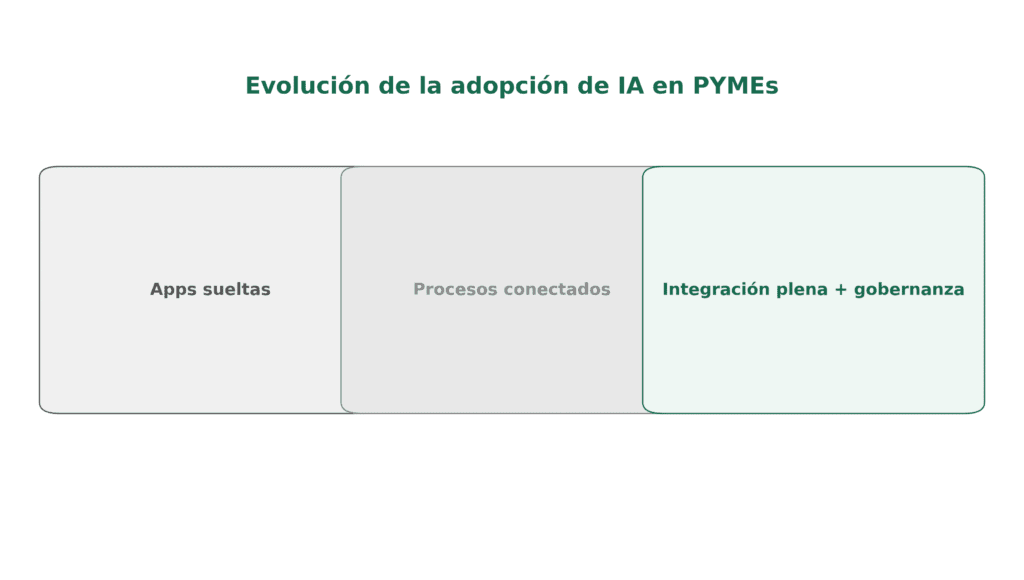
- It moves from standalone apps to integrations with CRM, ERP, telephony, or BI. (This point is key for the pilot to reach production.)
- Apply “MLOPs light”: prompt control, versions, validation, rollback.
4.6. People and training
- Training by role: sales, support, back-office.
- Simple 1-page guides per use case.
- Measure adoption: weekly usage, satisfaction, errors avoided.
5. Applicable ROI formulas
AI cannot remain at the level of vague promises: the return must be measure.Below you will find simple formulas and examples that any SME can adapt to its own situation to make decisions based on numbers, not just feelings.
5.1. General ROI Formula
The simplest one is:
ROI = (Profit obtained − Investment) ÷ Investment
- Saving working hours (administrative automation, support).
- Additional income (faster sales, better conversion).
- Costs avoided (errors, losses, penalties).
👉 If you want to apply these calculations to your context, you can use the Basic ROI calculator From Rumbo & Resultados:
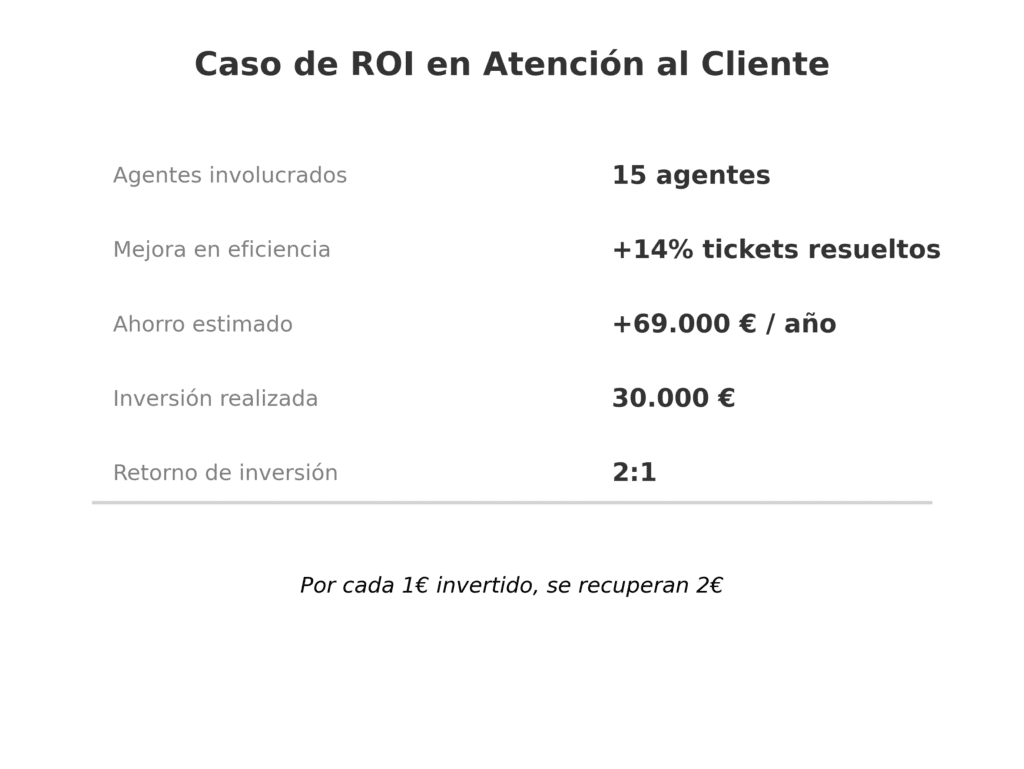
5.2. Case study: customer service with 15 agents
Let's imagine a team of 15 support agents which serves an average of 8 tickets per hour (typical ratio in many customer service departments):
- Base: 8 tickets/hour per agent.
- With AI assistance → +14% of productivity → 9.1 tickets/hour.
- Result: +2,310 tickets/month without expanding the workforce.
- Estimated value: €2.50 marginal cost per ticket → +€69,300/year.
- Annual investment (tool + integration + training): €30,000.
- ROI ≈ 2.3:1 → payback in less than 6 months.
5.3. Case study: invoice automation
Let's assume that an SME processes 5,000 invoices per year. The average manual time is 5 minutes per bill (figure aligned with typical back office benchmarks):
- Volume: 5,000 invoices/year.
- Manual time: 5 minutes per invoice → 417 h/year.
- With AI, time drops to 1 min → 83 hours/year.
- Saving: 334 h/year.
- If cost/h = €20, savings ≈ €6,680/year.
- Software investment: €3,000/year → ROI ≈ 1.2:1 the first year.
5.4. Case study: marketing and sales
Various productivity reports indicate that AI can increase business productivity by up to 20–301% of total productivity. Let's imagine an SME that goes from 5 days to 24 hours in the preparation of proposals:
- Previously: 5 days to prepare a proposal → 55% closing rate.
- With AI: 24 h → 70% closing rate.
- Over 100 proposals/year → +15 additional closures.
- If average ticket = €10,000 → +€150,000 in extra sales.
- Investment in tools: €20,000/year.
- ROI ≈ 6.5:1.
| Metrics | Manual | With AI |
|---|---|---|
| Time per invoice | 5 min | 1 min |
| Total hours | 100 h | 8 pm |
| Cost/hour | 20 € | 20 € |
| Saving | 1.600 € | |
| Investment | 1.000 € | |
| ROI | 60% | |
6. Action plan: 3 waves over 12 months
Adopting AI in an SME doesn't happen overnight. To avoid improvisation and fragmentation, it's advisable to work on... waves of implementation, each with a clear focus, a defined time horizon and KPIs.
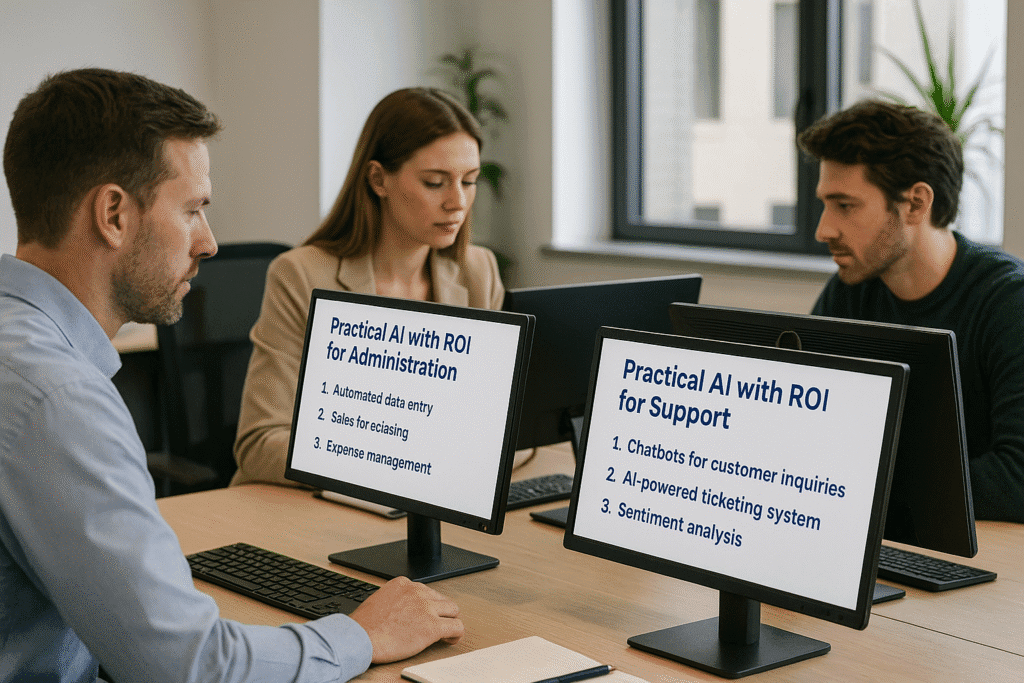
6.1. Wave 1 (0–90 days): immediate efficiency
- Aim: free up time and reduce costs quickly.
Typical actions:
- AI-assisted support (summaries, suggestions, quick answers).
- Automation of documents and invoices.
- Office co-pilots (proposals, reporting, minutes).
- KPIs: Tickets resolved/hour, average proposal time, administrative hours saved.
- Responsible: Area manager (support, administration) with IT support.
6.2. Wave 2 (90–180 days): revenue and operations
- Aim: go from saving to sales growth and operational efficiency.
Typical actions:
- Lead scoring and opportunity prioritization.
- Simple demand forecasting for purchases and stock.
- Operational QA with AI (incident detection).
- KPIs: conversion rate, reduction of stockouts, incidents detected.
- Responsible: Commercial director + operations manager.
| Area | Action | KPI |
|---|---|---|
| Commercial | Lead scoring | Conversion rate |
| Operations | Demand forecast | Stockouts |
| QA | Incident detection | Number of incidents avoided |
6.3. Wave 3 (180–365 days): scaling and governance
- Aim: integrate AI into core processes and ensure compliance.
Typical actions:
- Deep integration with ERP, CRM and BI.
- Formal definition of AI policy (data, uses, review).
- Ongoing training by role, with quarterly review of results.
- KPIs: number of active integrations, % employee adoption, regulatory compliance.
- Responsible: internal ad hoc committee (general management + IT + business).
7. Warning signs of not burning through budget
Many AI projects in SMEs fail not because of the technology, but because of planning errors. These are the red flags most common ones that should be detected early.
No business owner
- The project is led solely by IT or marketing, without business owner that measures the impact.
- Result: pilots that do not go into production.
“Nice” but marginal use cases
- Apply AI to secondary tasks (e.g., generating social media posts without a clear strategy or objectives).
- Result: Much ado about nothing..
Ambiguous or ungoverned data
- Inconsistent, duplicate, or outdated entries in your key systems.
- Result: unreliable outcomes, internal frustration, and legal doubts.
Do not measure from the beginning
- There is no baseline or starting KPI to compare before/after.
- Result: There is no way to prove the ROI, even though the project works in practice.
Over-engineering
- The aim is to build a data lake (a large digital warehouse where all the company's data is stored) or a complex machine learning model from scratch, without a clear need.
- Result: inflated costs, months of waiting, and zero return.
Ignoring regulations and safety
- Use of AI in HR or in customer processes without reviewing the AI Act or the GDPR, or defining internal policies.
- Result: legal risks and loss of trust from employees and customers.
If your company or SME wants to move forward with AI without losing focus or budget, remember these ideas:
- If you don't define ROI, there is no ROI. Every project should start with a use case with clear metrics.
- The pilot needs to have a watch. 8–12 weeks with defined KPIs, not endless experiments.
- Less is more. Start with minimum viable data and concrete cases, not with giant projects.
- AI does not replace: it amplifies. When used correctly, it multiplies the productivity of your teams.
- Letting it go is a step backwards. Competitors who adopt earlier will be faster, more efficient, and more attractive to talent.
Frequently Asked Questions about Practical AI with ROI
Quick answers to the most common questions when an SME wants to apply artificial intelligence with a measurable return, without getting lost in endless tests or oversized projects.
Where should a small business that doesn't yet use AI start?
Don't start with the tool; start with the business problem. Define 3–5 specific use cases where AI can save hours or improve revenue (for example: customer support, invoicing, preparing sales proposals) and prioritize them with a simple scorecard of impact, effort, data, and urgency. From there, design an initial 8–12 week pilot with clear KPIs.
How do I know if an AI pilot is actually working?
Before starting, establish a baseline (current situation) and 2–3 very specific KPIs: hours spent, response time, errors, proposal closure rate, etc. During the pilot, compare the before and after on these same indicators. If there is no quantifiable improvement or it is marginal, the pilot is not working, even if the tool is "cool.".
How do I calculate the ROI of an AI project in my company?
The general formula is simple: ROI = (Profit obtained − Investment) ÷ Investment. In practice, it combines three elements: time savings (automation), additional revenue (more sales or higher conversion rates), and avoided costs (errors, losses, penalties). To make it easier, you can use our Basic ROI calculator , designed precisely for this type of pilots.
What minimum volume do I need for AI to make sense in my SME?
You don't need to be a large company. AI starts to make sense when you have repetitive tasks with a certain volume (for example, hundreds or thousands of tickets per year, thousands of invoices, dozens of sales proposals per month). What matters is not just the quantity, but the cost per task and the impact of reducing time or errors in those processes.
Is it essential to have perfect data before starting?
No. For an SME, trying to "perfect" all the data before starting is usually a trap. Work with minimum viable data: clean up what's essential for the chosen use case, document the quality limits, and improve as you go. The critical thing is to avoid chaotic data (duplicates, outdated data) in the processes where you want to measure ROI.
What risks do I run if I implement AI without taking into account the AI Act and the GDPR?
The main risk is using sensitive data (from employees or customers) in models or tools without a legal basis, without clear information, and without security controls. This can lead to penalties, loss of trust, and project blockages. Therefore, we recommend a 1–2 page AI usage policy, human-in-the-loop as the default for critical processes, and reviewing whether your case falls into any risk categories according to the European AI Act.