
And after the Digital Kit, what's next?
Thousands of SMEs have received aid from Digital Kit and from Kit Consulting, They have a new website, social media profiles, and several "cloud-based" tools... but the business remains the same.
Published December 4, 2025 · Category: Strategy · AI and digitization.
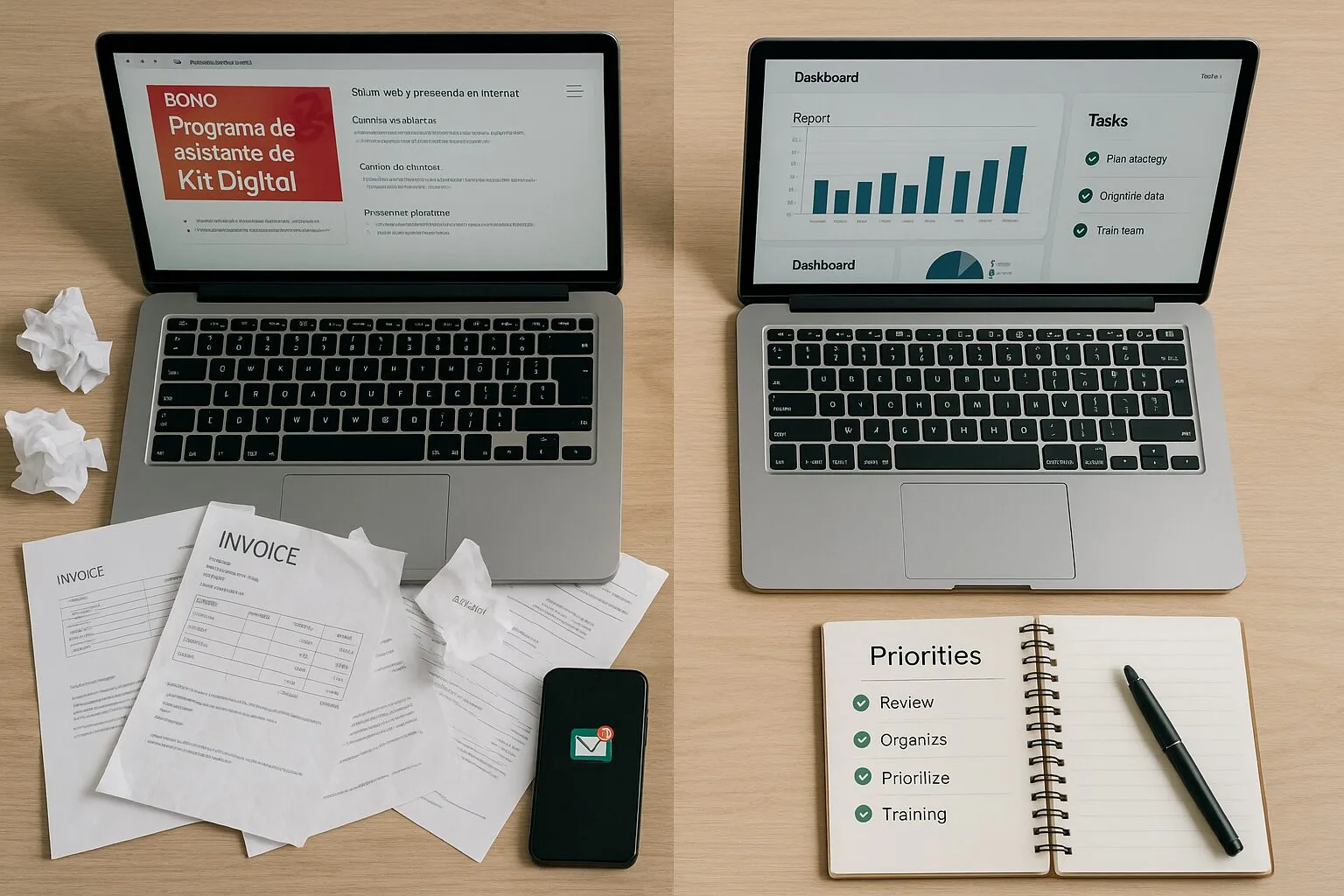
This article analyzes why so many implementations are failing to deliver results, what mistakes are being repeated, and what concrete steps you can take now to ensure your digital investment pays off.
finally start working.
- What the Digital Kit and the Consulting Kit promised (and what the SME has found)
- Real frustrations after implementing the Digital Kit
- Five basic mistakes that leave your website and systems "dead"“
- It's not a problem of tools: it's a problem of approach
- What to do now with what you already have: roadmap after the Digital Kit
- Why Rumbo & Resultados never wanted to be an agent of the Digital Kit
- Conclusion: From “they made me a website” to “my digital channel works”
- Frequently asked questions about Digital Kit and SMEs
1. What did the Digital Kit and the Consulting Kit promise (and what has the SME found)
Over the past few years, thousands of Spanish SMEs have taken refuge in Digital Kit with the expectation of making a real leap in their digital transformation.The narrative was simple and very attractive: "You'll have a modern website, active social networks, digital tools, and all of this practically at no cost.".
Later he arrived Kit Consulting, This additional support was designed to offer strategic advice on digitalization, data, automation, and even artificial intelligence. Many companies received it between 2024 and 2025, until the program's closure on March 31, 2025.
If one only looks at the official picture, the numbers are impressive: hundreds of thousands of beneficiary companies and billions mobilized from European funds, through entities such as Accelerate SMEs o Red.es.
If we move from the official document to the day-to-day reality of SMEs, the conversation is very different:
- “They made me the website for the Digital Kit, but No one visits her.”
- “They opened social media accounts for me, but they are dead for months.”
- “We signed a CRM, but Nobody uses it on the team.”
- “We had Kit Consulting sessions, but We continue working the same way. than before.”
This article answers a specific question: “After the Digital Kit, what’s next?”.In other words: what has gone wrong, what patterns are repeated in most SMEs, and what makes sense to do now with the website, the tools, and the aid already granted, both from Digital Kit as of Kit Consulting.
2. Real frustrations after implementing the Digital Kit
Beyond institutional propaganda, what you hear when you talk to SMEs is quite homogeneous: frustration, a feeling of being cheated, and the impression that the program has generated more noise than results..
Added to this are structural problems that have been appearing in media outlets, offices and specialized forums:
Common frustrations with the Digital Kit
- Complex bureaucracy. Applications, deadlines, justifications, fear of making a mistake and having to return the aid.
- Inconsistent quality of services. Cloned websites, poor design, non-existent SEO, social media without a strategy.
- Saturated digitizing agents. High-volume projects, "factory" models, and little real dedication to each SME.
- Hidden costs. VAT, maintenance fees, high renewals, and difficult-to-understand conditions.
- Mismatch between what was contracted and what the business needed. Tools chosen from a catalog, not from a diagnosis.
To this we must add the point that almost no one acknowledges publicly: many SMEs They did not receive sufficient training nor any real support to help their teams learn how to work with the new systems.
The result is not surprising:
| Symptom in SMEs | Probable cause | What does this mean in practice? |
|---|---|---|
| Digital Kit website without visits or contacts | There is no traffic or content strategy, minimal or non-existent SEO. | The website is a static brochure, not a lead generation channel. |
| Open and abandoned social networks | They were created out of obligation to justify the bonus, without a schedule or responsible party. | Neglected brand image and a feeling of neglect |
| CRM or management software that nobody uses | Implementation without reviewing processes or team capabilities | We're going back to Excel and WhatsApp; the tool is just for show. |
| Kit Consulting sessions with no visible changes | One-off diagnosis, without any operational procedures or follow-up. | Another PDF in Drive and the perception of "another useless consultancy"“ |
These frustrations are compounded by extreme cases: poorly executed work, websites that damage the company's image, clients who feel held hostage by their digitization agent, or even legal problems arising from poor management of the aid.
3. Five basic mistakes that leave you with a dead website and tools that nobody uses
If your company has gone through the Digital Kit and/or by the Kit Consulting And today “nothing is happening”, you are almost certainly trapped in a combination of these mistakes.
Error 1. Confusing a grant with a strategic project
Many have thought: "If there's help available, I'll take it and we'll see.".
The problem is that it has begun for the money, not the strategy.First, we looked at what the program was funding, and then we tried to fit the company's reality into that catalog.
Error 2. Leaving the decision in the hands of the digitizing agent
Instead of starting from a clear internal diagnosis, the approach has been: "Tell me what you're going to give me with this bonus.".
Result:
- Solutions that the supplier knows how to deliver, not the ones the business needs.
- Websites or online stores without a business model or customer acquisition strategy behind them.
- Licenses and platforms that fit better into the agent's catalog than into the team's operations.
Error 3. Implementing without considering the team's capabilities
CMS, CRM, BI tools or collaborative suites have been implemented without asking basic questions:
- Who's going to feed this on a daily basis?
- Who has the time and real digital skills to do it?
- What habits and processes will need to change to make it make sense?
Without that prior reflection, the result is logical: the team returns to Excel, WhatsApp, and manual tasks, and the tools in the Kit end up looking like expensive decorations.
Error 4. Measuring success by “having it done” instead of by results
In many cases, the success criterion has been:
- “The website has been delivered.”.
- “The consultant’s report has been submitted.”.
- “The aid is justified.”.
None of this has anything to do with real results:
- Does it generate more business opportunities?
- Does it help to sell better and with a higher margin?
- Does it reduce errors and wasted time?
- Does it provide real visibility into what's happening in the company?
As long as the KPI is "project closed" instead of "real change in the business", frustration is guaranteed.
Mistake 5. Thinking that one counseling session fixes everything
He Kit Consulting, The report, which many SMEs received between 2024 and 2025, provided useful diagnoses and roadmaps in theory. But in practice, too often it remained just that:
- One-off sessions without continuity.
- Beautiful roadmaps that nobody puts into practice.
- Zero support in changing the team's habits.
Without consistency, without reviewing progress, and without helping the company implement decisions, that advice becomes one more PDF in a Google Drive folder.
4. It's not a problem of tools: it's a problem of approach
It's easy to blame the Digital Kit, to the provider or even to the technology itself, but in most cases the tools are reasonable: a well-configured WordPress site, a standard CRM, a modern collaborative suite…
The real problem is something else: trying to make them work without:
- A clear strategy business and marketing.
- Priorities defined 12–18 months.
- A specific operation (who does what, when and according to what criteria).
- Method and organization to sustain the work over time.
- Minimum training so that the team feels capable, not threatened.
- Digital culture that values data and processes, not just the urgency of day-to-day life.
Therefore, the important question is not whether the Digital Kit It hasn't been good or bad, but what approach are you going to take now? digitization strategy you already marketing plan so that the investment starts to pay off.
5. What to do now with what you already have: roadmap after the Digital Kit
The good news is that, in most SMEs, it's not necessary to throw everything away and start from scratch. What's needed is put in order and make informed decisions about what to keep, what to adjust, and what to leave behind.
A realistic roadmap for the next 12 months could follow these steps:
Step 1. Honestly audit what you have
Before applying for another grant or redesigning the website, we need to take a hard look at the current situation:
- What tools have been implemented with the Digital Kit?.
- What is actually used in everyday life and what is not.
- What results is the current website producing (visits, contacts, sales)?.
- What the team knows how to do and what causes them to reject or block them.
This analysis can be based on internal resources or an external diagnosis, but in both cases it must be brutally honest.
Step 2. Return to business objectives, not tools
The next question is not "what more can I ask for", but:
- What do I want to achieve in terms of revenue, margin, and business stability?
- What role should the web, the digital channel, and CRM play in this?
- What is my team's actual capacity to sustain this week after week?
Services like this fit naturally. Competitive Marketing Plan wave Advanced Digital Strategy , who focus on the direction, not on the latest trend.
Step 3. Decide what to keep, what to adjust, and what to discard
Not everything done with the Digital Kit deserves to be preserved. Some simple criteria:
- If the tool is sound and the problem is related to its use, it is advisable to maintain it and work on its operation.
- If the tool is mediocre, but can be improved with reasonable adjustments, it makes sense to optimize it.
- If the website or system damages your image or blocks the team, it's best to accept it and start over.
Step 4. Design a minimum operating procedure that the team can sustain
Without operations, there is no transformation. We're talking about very specific things:
- Content and campaign calendar aligned with the business plan.
- Weekly routines for CRM updates and opportunity tracking.
- Short meetings to review digital indicators (not just sales).
- Simple internal guidelines so people know what to do and how.
Step 5. Form and support the team
The practical training It is the great missing element of the Digital Kit: it is not enough to show where each button is, you have to help people change the way they work.
This implies:
- Short sessions, highly focused on day-to-day life, not generic courses.
- Support for a few weeks to consolidate habits.
- Safe spaces for the team to ask questions and make mistakes.
Step 6. Review each quarter and adjust course
Digitalization and digital marketing are not projects that "end." They are living systems.
That's why it makes sense to review every quarter:
- What has worked and what hasn't.
- Which tools add value and which ones no longer do.
- What adjustments need to be made in strategy, messaging, and channels?.
6. Why Rumbo & Resultados never wanted to be an agent of the Digital Kit
At Rumbo & Resultados we decided from the beginning not to be digitizing agents of the Digital Kit.Not because digitization is foreign to us—it's a central part of our work—but because we saw very early on that the model was pushing towards something we didn't agree with and could have a negative reputational impact:
- Focus on volume, not depth.
- Fit the SME into the program's catalog, not adapt the service to its reality.
- Fit the SME into the program's catalog, not adapt the service to its reality.
- Prioritizing administrative justification over actual results.
- Selling “deliverables” instead of building internal capabilities.
- Promising structural changes without operational support.
For an authoritative strategic consultancy, this is a problem: the SME doesn't need another website, another tool, or another PDF. What it needs is address, order, method and real support and training that will allow them to sustain that transformation when the sessions, the grant, or the provider ends.
While the Digital Kit focused on “what tools can I give you”, at Rumbo & Resultados we focus on:
- Define a coherent digital and commercial strategy.
- Design processes and routines that the team can maintain.
- Create a marketing structure that generates real demand.
- Use AI in a practical (not cosmetic) way to free up hours and reduce errors.
- To train and support the team so that all of this becomes a habit.
That's why our approach is better suited now—when the grant has already been used or exhausted—than during the program itself. What we do is help SMEs to build what aid couldn't solve: a clear, realistic and measurable way of working.
7. Conclusion: the question is not “what have they done to me”, but “what do I do about it now”
He Digital Kit and the Kit Consulting They're already part of the past. What matters now is what you do with what you already have in place: your website, your networks, your management tools, and your team.
The solution isn't another grant or another tool. The solution is:
- honestly review what you have,
- order priorities and processes,
- define a clear marketing strategy and plan,
- to build the team and support them through the change,
- and establish a way of working that can be sustained over time.
Only then will the tools begin to generate real value. The support will have served a purpose beyond simply "having a website built": it will have been the start of a functional digital channel and a company with greater control over its future.
Frequently asked questions about Digital Kit and SMEs
A section designed to answer common questions and to help searchers and assistants better understand the real context of the Digital Kit in SMEs.
Should we discard everything that was done with the Digital Kit?
In most cases, no. Many websites, CRMs, or tools can work if they are reviewed and used correctly. The important thing is to identify what works, what hinders progress, and what can be optimized before deciding to discard everything and start from scratch.
Does it make sense to keep trying to get something out of what I did with the Digital Kit, or is it better to start from scratch?
The real question is: “"If this is done properly, could it work?"”.If the technical foundation is sound, then yes, it makes sense to continue and optimize. If the website or tool is so bad that it damages your image or is unmanageable, then it's worth considering a replacement. For most SMEs, the realistic approach is to improve what already exists.
How do I know if the problem is the tool or how I'm using it?
Quick tracks:
- If the tool is faulty or incorrectly assembled, the problem is technical.
- If the tool is correct but nobody uses it, the problem is one of operation, training, and approach.
In many SMEs it is a mix of both things, which is why a diagnosis is needed that looks at technology and working methods at the same time.
What is the first step if I'm stuck with everything that's been implemented?
The first step is to take inventory and perform a simple diagnosis:
- what do you have,
- what do you actually use,
- What do you want to achieve?,
- and what are the actual capabilities of your team?.
From there, a viable plan is built. Trying to add more tools without this analysis only exacerbates the problem.
👉 If you run an SME and recognize yourself in this post-Digital Kit scenario, We can help you turn what you already have into something that really works: a website that drives traffic, tools that are used, and a way of working that generates results, not frustration.
Would you like us to notify you when we publish new content?
We value your time. We'll only send you articles, guides, or tools that help you improve, make better decisions, or take better action.
Our practical resources and online tools

Checklist for managing green infrastructure projects
Evaluate whether your municipality has the necessary capacity to manage and coordinate infrastructure projects

Checklist for green and blue infrastructure strategy
Evaluate in 2 minutes whether your municipality has the necessary foundation to advance in infrastructure

Checklist for operational models of urban green spaces
In just a few minutes, determine if your municipality has a solid operational model for management.

Checklist for citizen communication in the environment
Check in minutes if your municipality effectively communicates its environmental initiatives and succeeds in engaging people