

1. From the theoretical plan to the plan that moves the needle
Having a marketing plan doesn't guarantee results. Many SMEs feel they've gone from improvisation to strategy, when in reality they've only replaced a lack of direction with an excess of tasks. competitive marketing plan It is not measured by the number of shares, but by its ability to move the needle in the business.
Following the impetus of Digital Kit, Many companies have "digitalized" overnight: new website, CRM, campaigns, and automation. But digitizing It's not about transforming. Digitization without purpose produces the same results as before, only more expensive. What sets a competitive plan apart is that it connects tools with decisions, and decisions with results.
A competitive plan doesn't fail due to a lack of ideas, but due to a lack of focus, judgment, and follow-through.
2. Mistake 1 – Confusing a plan with an action schedule
The most common mistake is confusing having a plan with having a list of actions. Quarterly campaigns, posts, trade shows, or newsletters… it all seems strategic until you ask: What specific result was each action seeking? When marketing becomes a calendar, the team gets confused. activity with progress.
According to the HubSpot State of Marketing 2025 report,Over 60% of SMEs admit to investing in channels without connecting their actions to a clear objective. The result: constant effort but without direction.
How to detect it
- They celebrate "having done a lot", but no concrete business results are shown.
- The actions are not linked to measurable objectives.
- New initiatives are launched every month without evaluating the previous ones.
- The plan is extensive, but there are no clear priorities.
If your plan is measured by the number of posts or campaigns —and not by sales, margin or repetition— you are managing a calendar, not a strategy.
How to fix it
1) Start with the objectives (what result do you want to achieve) and then define the actions that best serve that purpose.
2) Apply a decision filter: Each idea must answer the questions "Does it help a specific goal?" and "What is not being done in return?".
3) Reduce volume to gain focus: Three well-executed actions outweigh ten scattered ones. A competitive plan is selective, not exhaustive.
3. Error 2 – Measure what is visible and forget what matters
Vanity metrics—visits, likes, impressions—create a sense of movement, but they don't demonstrate real progress. Measuring what's visible is convenient; measuring what's important requires connection. marketing with business. As he emphasizes Think with Google,The key is to "measure what really matters.".
Real example. An industrial SME celebrated a 40% increase in web traffic after a year of campaigns. However, the volume of accepted proposals didn't grow. The problem wasn't visibility, but rather a lack of connection between content and ideal customer. The plan was visible, but not competitive.
Which metrics do reflect progress?
| Guy | Metrics | Utility |
|---|---|---|
| Vain | Visits, impressions, likes, followers | Visibility; they do not indicate impact on sales or margin. |
| Business | Customers by channel, conversion to sale, time to first purchase, customer lifetime value at 12 months | They allow you to prioritize investment and decide what to continue or pause. |
Measuring without analyzing is counting, not directing. Data is only useful if it changes decisions.
How to avoid this mistake
- Simplify reports: a clear sheet with 3–5 critical indicators.
- Connect with business: sales, margin and repeat business; not just traffic.
- Quarterly review: Look for trends, not isolated photos.
When decisions are based on visibility metrics, teams tend to optimize superficial aspects: posts that generate engagement but not business, ads that attract unqualified traffic, or reports so long that no one reads them. The danger is believing you're making progress when you're simply wasting time.
The antidote is to use metrics as compass, not mirror. In each monthly review, ask yourself: What did we learn? What did we change thanks to the data? If the answer is "nothing," then you're not measuring; you're just taking notes.
4. Error 3 – Internal misalignment
It's the least visible and most expensive mistake: marketing on one hand, sales on the other, management failing to integrate information. On paper, the plan seems solid; in practice, it falls apart. shared focus.
A study by the LinkedIn B2B Institute indicates that companies with aligned marketing and sales grow by up to 200 % longer term. And according to Harvard Business Review,Misalignment is one of the factors that most destroys value in medium-sized companies.
Symptoms
- Marketing generates leads that sales does not consider valid.
- Management demands results without knowing what has been implemented.
- Customer messages change depending on who communicates them.
3C Method for Aligning Equipment
Share: Key monthly data accessible to all (results, cost, lessons learned).
Contrast: Perceptions between areas in 20–30 minutes (what worked, what held us back, what we tried).
Correct: agree on a specific improvement for the next cycle and assign responsibility and date.
How to regain coordination
1) Common language: agree on what constitutes “interested contact”, “opportunity” and “active campaign”.
2) Brief monthly ritual: 20–30 minutes to share results, lessons learned, and next steps.
3) Link marketing to sales indicators: not to find culprits, but to learn what generates value.
Parallel efforts
Different objectives; one team's work neutralizes the other.
One same course
Marketing as a sales lever; agile decisions with shared data.
5. Practical lessons: what actually works
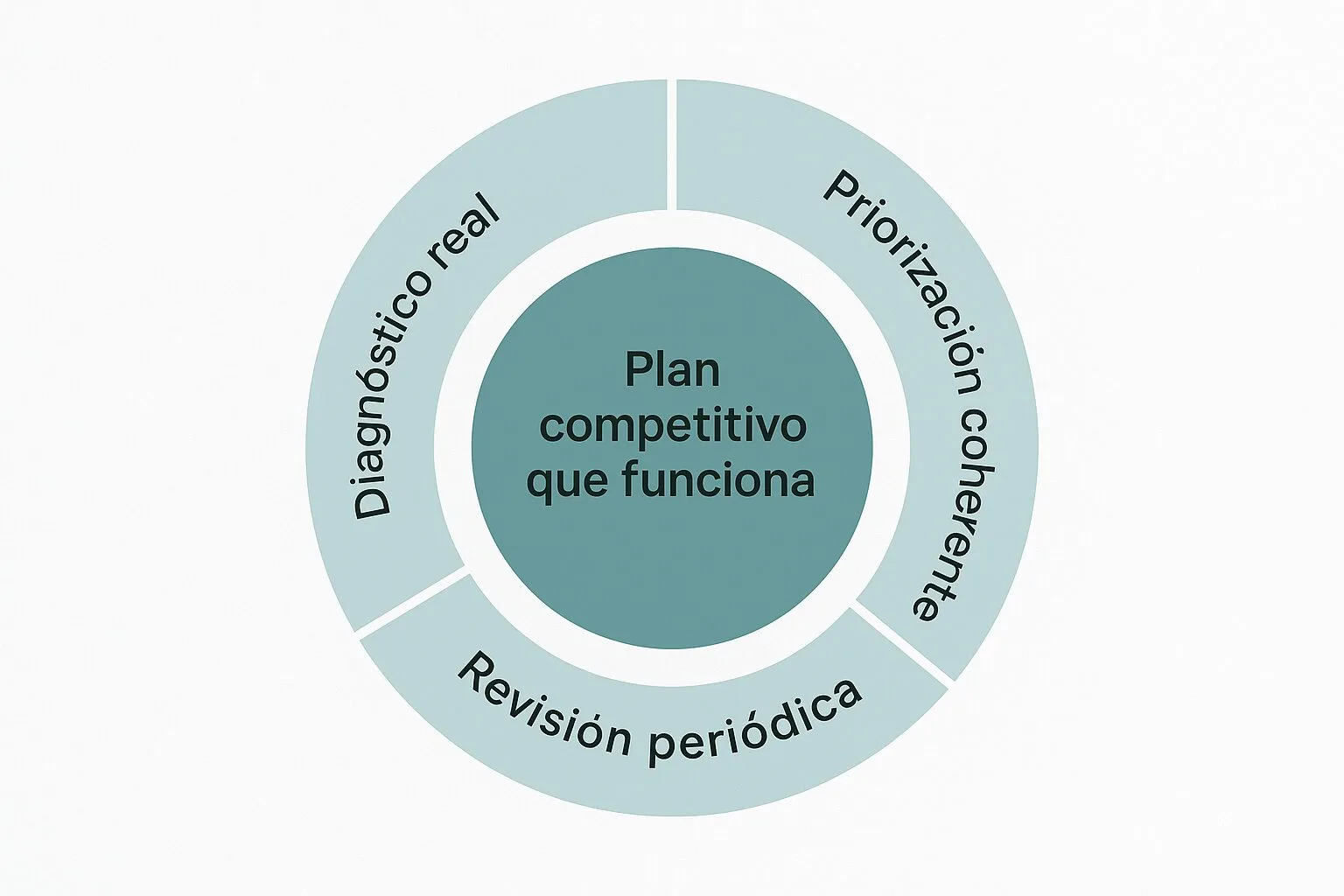
A competitive marketing plan is built as a compass, not a clockIt doesn't seek pinpoint accuracy, but rather consistent direction. The goal isn't to predict the market, but to learn faster than the competition. SMEs that understand this stop chasing perfection and begin to move forward coherently.
A clock measures the passage of time; a compass reminds you where you're going. In marketing, chasing excessive precision leads to analysis paralysis. Competitiveness lies in moving with direction, knowing when to adjust course. The company that reviews its direction most frequently—and acts accordingly—gains ground, not the one that runs the fastest.
6. Compass, not clock: the idea to remember
Mark what you recognize in your company today:
- Actions are planned before defining objectives.
- The reports show nice data, but not decisions.
- The teams do not review results together.
- Priorities change every month.
- Nobody could summarize the plan in one clear sentence.
A marketing plan shouldn't make you work more, but rather help you make better decisions. Avoiding these mistakes doesn't require more resources, but rather clarity of direction and disciplined follow-through.